Rottweiler Feeding Chart: Cups Per Day by Weight
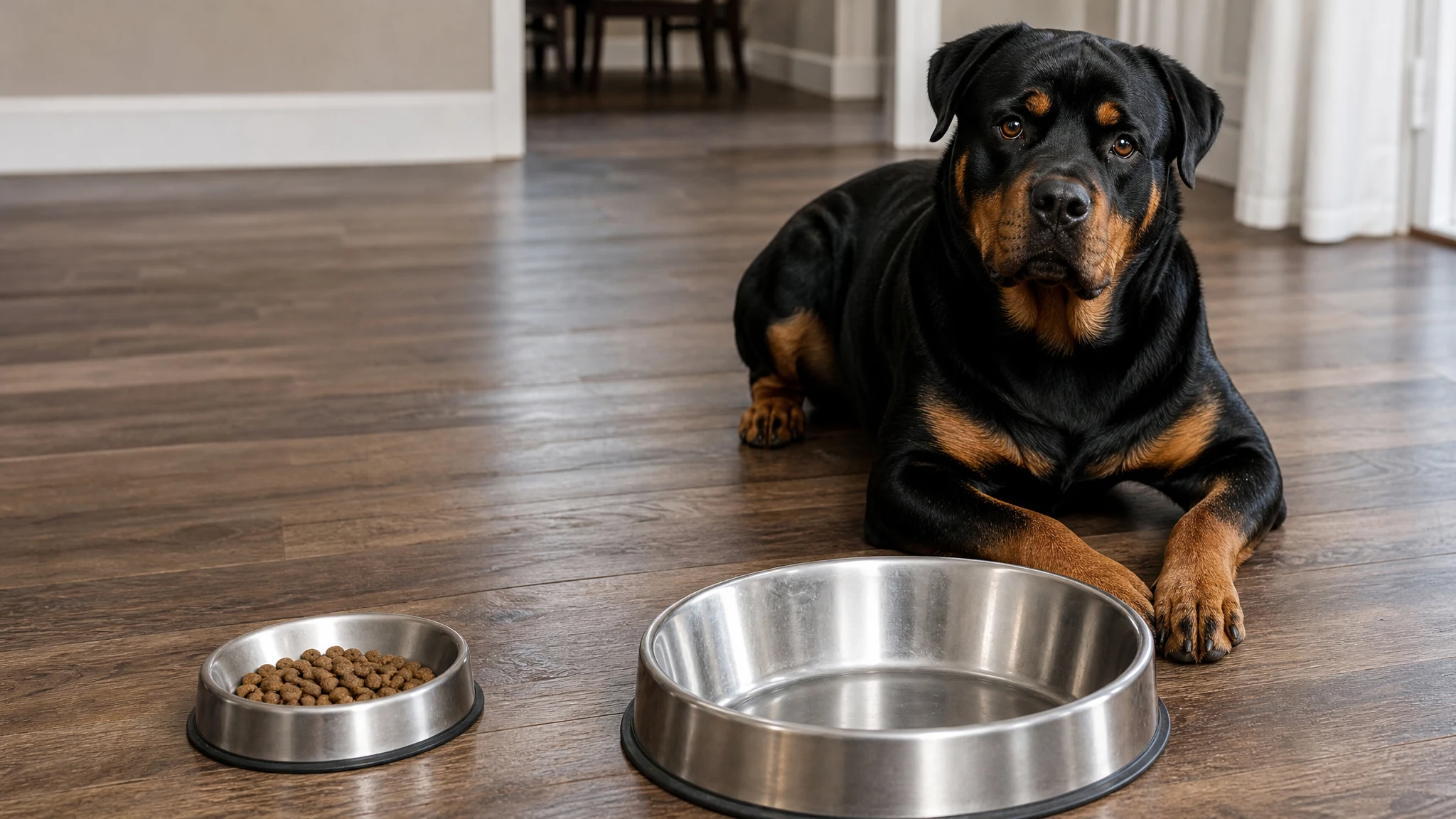
General nutrition information compiled from product labels and published sources, not veterinary advice. Your veterinarian is the right person to choose a diet for your dog, especially one with a health condition.
Every bag of dog food comes with a feeding table, and no two tables agree. A Rottweiler owner who switches brands can end up with a very different portion for the same dog. This guide shows how to read those tables and build a rottweiler feeding chart you can actually use.
The amounts below come from the brands' own feeding guides. We compared label data. We did not run feeding trials or taste tests. Treat every number as a starting point, not a prescription.
Why a Rottweiler needs its own chart
Hill's Pet Nutrition lists adult Rottweilers at roughly 80 to 135 pounds, with males usually heavier than females. That is a wide range. A 15-pound gap in body weight can change the daily portion by a cup or more.
Hill's also says Rottweilers are considered adults at about 12 to 18 months. It notes that less activity with age can lead to extra weight, and that lean body condition supports joint health. Hip and elbow dysplasia are the joint problems it names for the breed. Portion control is one part of keeping a Rottweiler lean. It does not prevent or treat any condition.
What you need
- The food bag or can, with its feeding guide and calorie statement
- A dry measuring cup (a scoop that came with the food is not a standard cup)
- A kitchen scale. Hill's recommends measuring daily portions on one.
- Your dog's current weight from a home or vet scale
- A notebook or phone note for weekly weigh-ins
- Your veterinarian's contact, for any health question
Step 1: Find your dog's life stage
Puppies and adults use different formulas and different tables. Royal Canin's Rottweiler puppy formula covers 8 weeks to 18 months. Its Rottweiler adult formula is for purebred Rottweilers 18 months and older.
Hill's advises a large-breed puppy formula for Rottweiler puppies, with controlled bone and joint growth. Do not feed an adult food to a puppy because the bag is bigger or cheaper. Check the AAFCO statement on the label. It should say the food is formulated for growth or for all life stages, including growth of large dogs.
Step 2: Weigh your dog
Use your dog's real weight, not the breed average. Weigh at the same time of day, ideally before a meal. If you cannot fit a dog this size on a bathroom scale, ask your vet's office whether you can use theirs.
Write the number down. You will compare it against future weigh-ins.
Step 3: Read the food's own feeding table
The chart below pulls the amounts each brand prints for dogs near Rottweiler size. Only weights the brand actually lists are shown. Anything else would be guesswork.
| Food | Label guide | Calories on label |
|---|---|---|
| Royal Canin Breed Health Nutrition Rottweiler Adult (dry) | 88 lb at low activity: 4 cups (369 g) per day. The table runs from 88 to 128 lb and rises with activity. | 366 kcal ME per cup |
| Royal Canin Breed Health Nutrition Rottweiler Puppy (dry) | 2 months, target adult weight 88 lb: 3 cups (293 g) per day | 358 kcal ME per cup |
| Hill's Science Diet Adult Large Breed Chicken & Brown Rice (dry) | 50 lb: 3 cups per day. 100 lb: 5 cups per day. | 390 kcal per cup |
| VICTOR Classic Elite Canine (dry) | Add 1/2 cup for every 20 lb over 100 lb | 386 kcal per cup |
| Freshpet Chunky Chicken & Turkey roll | 61 to 100 lb: 1 1/2 to 2 lb per day. Over 100 lb: 2 lb plus 1/4 lb for each added 25 lb. | 304 kcal per 1/2 lb |
Two things stand out. First, the cup amounts are not interchangeable. A cup of Hill's adult large breed lists 390 kcal and a cup of Royal Canin Rottweiler Adult lists 366 kcal. That is a real difference over a month of meals. Second, a few brands do not print every weight we would want. Hill's puppy large breed page says to adjust amounts to maintain optimal weight and to ask your veterinarian if unsure. For a full chart, check the brand's page or bag.
For amounts by age rather than weight, see our Rottweiler feeding chart by age.
Step 4: Measure each meal
- Look up the daily total on your food's table.
- Weigh that amount on the scale, or level a dry measuring cup. Royal Canin states that one cup of its Rottweiler Adult is 94 g, so grams are a reliable check.
- Split the total into meals. Most owners of large dogs use two meals a day, and your vet can advise on the right split for your dog.
- Count treats and chews. They add calories that the table does not include.
Step 5: Adjust by body condition
The table is a starting point. After two to three weeks, check your dog's body condition. You should be able to feel the ribs under a thin layer of padding. Looking down from above, there should be a visible waist.
If the ribs are hard to feel, trim the portion a little. If they are very easy to see, ask your vet before raising it. Small changes work best, and weekly weigh-ins show whether the change is working.
Step 6: Switch life stages on schedule
Royal Canin says to move from its Rottweiler Puppy formula to Rottweiler Adult after 18 months. Hill's describes large-breed puppy food as suitable up to 18 months. Change foods over several days by mixing the new food with the old in growing amounts. This is a common practice that is easier on the stomach. Your vet can suggest a timeline for your dog.
Tips and common mistakes
- Using the scoop in the bag. It may not be a standard cup. Weigh it once to find out.
- Feeding by the bag's weight range alone. The Royal Canin table starts at 88 lb. A lighter dog needs a different source of guidance.
- Forgetting activity. A couch-loving adult and a working-dog adult can need quite different amounts.
- Ignoring treats. Cut the meal slightly on heavy training days.
- Changing food and amount together. Change one at a time so you can tell what caused any change in weight or stool.
- Comparing cups across brands. Compare calories per cup and the daily total instead.
- Assuming a puppy formula can be fed forever. Check the label for the intended life stage.
What to expect
With steady measuring, many owners find their dog's weight settles within a few weeks. A dog that is fed a suitable amount may keep a healthy body condition and steady energy. Results vary by dog, and no feeding chart can promise a particular outcome.
Hill's notes that staying lean supports joint health in the breed. That is general guidance, not a treatment. If your Rottweiler has a health condition, such as a joint, heart or digestive problem, confirm every amount with your veterinarian. Prescription diets are something only a veterinarian prescribes. Do not add supplements without asking your vet first.
Quick recap
- Pick a food made for your dog's life stage.
- Weigh your dog and write it down.
- Find the daily amount on that food's own table.
- Measure by weight with a kitchen scale.
- Check ribs and waist, and adjust slowly.
- Re-weigh weekly and call your vet with questions.
Sources
- Hill's Pet Nutrition, Rottweiler breed page
- Royal Canin, Breed Health Nutrition Rottweiler Adult
- Royal Canin, Breed Health Nutrition Rottweiler Puppy
- Hill's Science Diet, Adult Large Breed No Corn, Wheat, Soy Chicken & Brown Rice
- Hill's Science Diet, Puppy Large Breed Chicken & Brown Rice
- VICTOR, Classic Elite Canine
- Freshpet, Chunky Chicken & Turkey Dog Food Roll