How Much to Feed a Rottweiler: Feeding Chart by Age and Weight
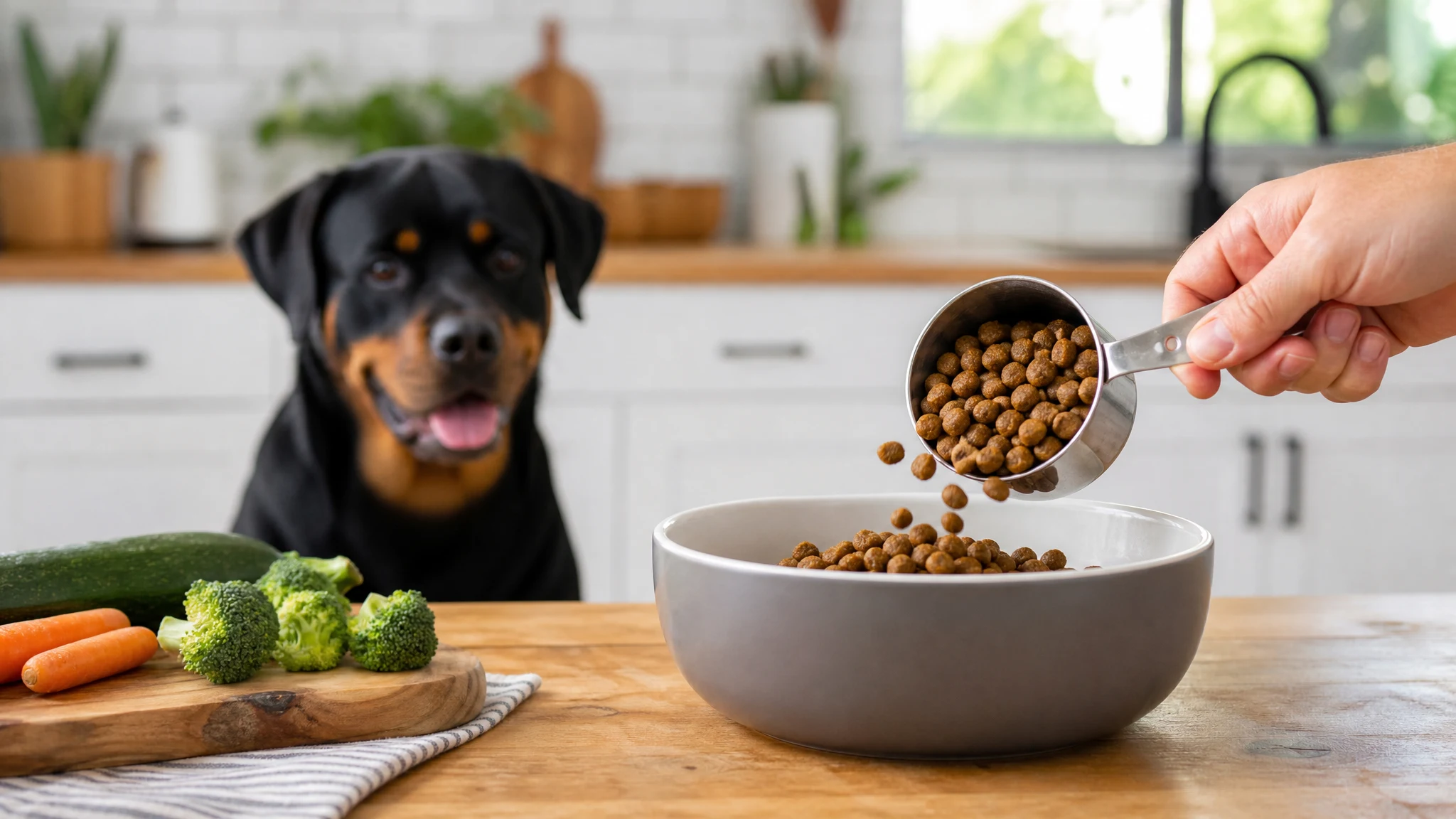
General nutrition information compiled from product labels and published sources, not veterinary advice. Your veterinarian is the right person to choose a diet for your dog, especially one with a health condition.
Working out how much a Rottweiler should eat is harder than reading one number off a bag. Adult Rottweilers range from 80 to 135 pounds, according to the Hill's Pet Nutrition Rottweiler breed page. Males are usually heavier than females. A dog at the low end and a dog at the high end need very different amounts.
This guide shows you how to build a starting amount from a food's own feeding guide. Then you adjust it by watching your dog's body. The chart below uses label data from specific products and names the label each figure comes from.
Label guides are starting points. A veterinarian sets the amount for an individual dog.
What You Need
- The bag or can of the food you actually feed, with its feeding guide and calorie statement
- A kitchen scale that reads in grams or ounces
- A measuring cup, for comparison with the scale only
- A bathroom scale or a vet-clinic weigh-in for your dog's current weight
- A notebook or phone note for weight, portions and treats
- Your veterinarian's contact details for the final decision
How We Built the Chart
We compared label data. We did not run feeding trials or taste tests, and we did not feed any of these foods to dogs. Every amount below is what the brand printed on its own product page. The calorie arithmetic is simple multiplication of those printed figures.
For a wider look at ingredients and nutrient figures, see our label-by-label comparison of foods for Rottweilers.
Step 1: Know Your Dog's Life Stage
Feeding depends heavily on age. The Hill's breed page says Rottweilers reach adulthood at 12 to 18 months. It lists a life expectancy of 9 to 10 years.
The stages that matter for the food bag are:
- Puppy: Royal Canin's Rottweiler Puppy formula is labeled for 8 weeks to 18 months. Hill's Science Diet Puppy Large Breed runs up to 18 months.
- Adult: Royal Canin's Rottweiler Adult is labeled for purebred Rottweilers 18 months and older. Hill's Adult Large Breed covers large breeds from 1 to 5 years.
- Mature adult: Hill's Adult 6+ Large Breed is labeled for large breeds 6 years and older.
Check the life stage statement on your bag. Feeding an adult food to a growing puppy, or the reverse, changes the nutrients the dog gets. Ask your veterinarian when to switch.
Step 2: Pick the Right Formula and Read Its AAFCO Statement
The AAFCO statement tells you which life stage the food was made for. Look for wording such as "for growth," "for maintenance" or "for all life stages."
The Hill's breed page advises a large-breed puppy formula for Rottweiler puppies, with controlled bone and joint growth. Some labels add that growth for large dogs (70 pounds or more as adults) is covered. Freshpet's Vital Chicken Recipe and Nom Nom's Beef Mash both say so on their product pages. Royal Canin's puppy page says the full statement is longer, so read the printed bag.
Step 3: Find the Calories Per Cup
Two foods can both say "1 cup" and deliver very different calories. Find the calorie figure on the label, then compare. The labels in our reference set print these figures:
- Royal Canin Rottweiler Adult: 366 kcal ME per cup (as fed, calculated)
- Royal Canin Rottweiler Puppy: 358 kcal ME per cup (as fed, calculated)
- Hill's Science Diet Adult Large Breed No Corn, Wheat, Soy Chicken & Brown Rice: 390 kcal per cup
- Hill's Science Diet Puppy Large Breed Chicken & Brown Rice: 387 kcal per cup
- Hill's Science Diet Adult 6+ Large Breed Chicken Meal, Barley & Rice: 352 kcal per cup
- VICTOR Classic Elite Canine: 386 kcal per cup
- VICTOR Classic Hi-Pro Plus Large Breed Puppy: 365 kcal per cup
Fresh and canned foods are measured differently. Freshpet and JustFoodForDogs print calories per kilogram or per pound, and Hill's wet food prints calories per 13 oz can. Nom Nom's Beef Mash lists 201 kcal per cup (calculated).
Step 4: Use the Rottweiler Feeding Chart as a Starting Point
This rottweiler feeding chart pulls the amounts that each brand printed for dogs in the Rottweiler weight range. Brands do not publish matching rows, so the weights differ from line to line. The calorie column is the printed amount multiplied by the printed calories per cup or can.
| Stage and weight | Food and label used | Label amount per day | Approximate calories from label figures |
|---|---|---|---|
| Puppy, 2 months, target adult weight 88 lb | Royal Canin Rottweiler Puppy, product page | 3 cups (293 g) | About 1,074 kcal (3 cups x 358) |
| Adult, 88 lb, low activity | Royal Canin Rottweiler Adult, product page (table covers 88 to 128 lb) | 4 cups (369 g); 1 cup = 94 g | About 1,464 kcal (4 cups x 366) |
| Adult, 100 lb | Hill's Science Diet Adult Large Breed No Corn, Wheat, Soy, product page | 5 cups | About 1,950 kcal (5 cups x 390) |
| Adult, 120 lb | Hill's Science Diet Adult Chicken & Barley Entree wet food, product page | 6 cans (13 oz) | About 2,208 kcal (6 cans x 368) |
| Adult, 61 to 100 lb | Freshpet Chunky Chicken & Turkey roll, product page | 1 1/2 to 2 lb | About 304 kcal per 1/2 lb, per the label |
| Adult, 101 lb and up | Freshpet Chunky Chicken & Turkey roll, product page | 2 lb plus 1/4 lb per additional 25 lb over 100 | About 304 kcal per 1/2 lb, per the label |
| Adult, over 100 lb | VICTOR Classic Elite Canine, product page | Add 1/2 cup for every 20 lb over 100 lb to the base amount on the bag | 386 kcal per cup, per the label |
A few things stand out. First, the Royal Canin and Hill's rows are for different dog weights, so do not read them as one brand feeding more than another. Second, the Hill's dry food chart shows 3 cups for a 50 lb dog and 5 cups for a 100 lb dog. Third, Hill's puppy and Adult 6+ pages tell you to adjust to maintain optimal weight and to ask your veterinarian. They do not give a fixed amount in the material we reviewed. Check the brand page or the bag for current tables.
Hill's wet food is a good example of why you should not mix up units. Its page says amounts run from 1/2 can for a 5 lb dog to 6 cans for a 120 lb dog, and the calories are per can, not per cup.
Some labels are less specific. The JustFoodForDogs Beef & Russet Potato page offers a feeding calculator with no fixed amount shown. Nom Nom points to its own Daily Feeding Guide. For those foods, use the brand's tool and confirm the result with your veterinarian.
Step 5: Weigh the Food, Do Not Scoop It
A scoop of kibble can vary by a surprising amount depending on how you fill it. The Hill's breed page recommends measuring daily portions with a kitchen scale, and that is the easiest habit to build.
- Put the empty bowl on the scale and zero it.
- Add the food until you reach the target weight in grams.
- Write the number down so everyone in the household feeds the same amount.
Royal Canin's own page lists a cup as 94 g for its adult formula. That is a useful check: a 4 cup amount becomes 369 g on its table. Weighing removes the guesswork.
Step 6: Score Your Rottweiler's Body Condition
The scale number is only half the picture. Body condition scoring tells you whether the weight is lean, ideal or heavy for your dog's build. Your veterinarian can show you the scoring system they use, often a 5 or 9 point scale.
You can do a quick check at home:
- Ribs: You should feel them easily under a thin layer of padding, without pressing hard.
- Waist: Look from above. There should be a visible narrowing behind the ribs.
- Belly tuck: Look from the side. The belly should rise from the chest toward the hips.
If you cannot feel the ribs, or the waist has disappeared, the dog may be carrying extra weight. If the ribs, hips or spine are very prominent, the dog may be too thin. Either way, talk to your veterinarian before making big changes.
This matters for a Rottweiler in particular. The Hill's breed page names hip and elbow dysplasia as common in the breed and says a lean body condition supports joint health. It also warns that reduced activity with age may lead to extra weight. Diet does not treat or prevent these conditions, and your veterinarian decides what is right for an individual dog.
Step 7: Adjust by Activity and Treats
Royal Canin's table varies by activity level, which shows how much activity changes the amount. Its example is an 88 lb dog at low activity, who gets 4 cups. A working or very active dog may need more, and a quiet older dog may need less.
Make changes slowly:
- Feed the label starting amount for two to four weeks.
- Check the scale weight and body condition every couple of weeks.
- If the dog is gaining or losing in the wrong direction, adjust the daily amount by a small step and check again.
- Count treats and chews as food. Take them out of the day's total.
When you change foods, the calories per cup may differ. Moving from a 352 kcal per cup food to a 390 kcal per cup food at the same volume is a real increase. Recalculate by weight and calories, not by cup count.
Step 8: Plan for Each Life Stage
Puppies
Growth is gradual. Royal Canin's puppy page gives 3 cups (293 g) at 2 months for a dog with an 88 lb target adult weight, and says to switch to Rottweiler Adult after 18 months. Other brands, including Hill's puppy page, tell you to adjust to maintain optimal weight. Ask your veterinarian how often to feed and how to track growth.
Adults
Most adults are on one food for years. Re-weigh regularly, because the amount that suited a young active dog may be too much later.
Seniors
Hill's Adult 6+ Large Breed lists 352 kcal per cup, lower than the brand's other large-breed dry foods here. Lower-calorie foods can suit less active dogs, but your veterinarian should confirm. With a 9 to 10 year life expectancy listed for the breed, ask for a senior check-up plan.
Tips and Common Mistakes
- Using the cup that came with an old bag. Weigh the food instead.
- Feeding by the bag weight range alone. A 100 lb dog with an overweight body score does not need the 100 lb amount. Your vet may target the ideal weight.
- Forgetting treats. Training treats, chews and table scraps add up.
- Switching foods overnight. Ask your veterinarian how to transition gradually.
- Comparing cups across brands. Compare calories.
- Reading an all life stages food as a puppy food. Check that the statement covers large-dog growth if you feed it to a puppy.
- Adding supplements on your own. Ask your veterinarian first.
What to Expect
If the amount is about right, many owners find that their dog keeps a steady weight, a visible waist and normal energy. Stools, appetite and coat may also stay consistent. These are signs to watch, not promises. Every dog responds differently, and a change in appetite, weight or stool is a reason to call your veterinarian.
The question of how much a Rottweiler should eat does not have a single answer. The label gives you the first number. The scale, the ribs and your veterinarian give you the right one.
Sources
- Hill's Pet Nutrition, Rottweiler breed page
- Royal Canin US, Breed Health Nutrition Rottweiler Adult
- Royal Canin US, Breed Health Nutrition Rottweiler Puppy
- Hill's Pet Nutrition, Science Diet Adult Large Breed No Corn, Wheat, Soy
- Hill's Pet Nutrition, Science Diet Puppy Large Breed
- Hill's Pet Nutrition, Science Diet Adult 6+ Large Breed
- Hill's Pet Nutrition, Science Diet Adult Chicken & Barley Entree wet food
- VICTOR Super Premium Pet Food, Classic Elite Canine
- VICTOR Super Premium Pet Food, Classic Hi-Pro Plus Large Breed Puppy
- Freshpet, Chunky Chicken & Turkey roll
- Freshpet, Vital Chicken Recipe
- JustFoodForDogs, Beef & Russet Potato
- Nom Nom, Beef Mash