Rottweiler Feeding Chart by Weight: How Much to Feed at Each Size
General nutrition information compiled from product labels and published sources, not veterinary advice. Your veterinarian is the right person to choose a diet for your dog, especially one with a health condition.
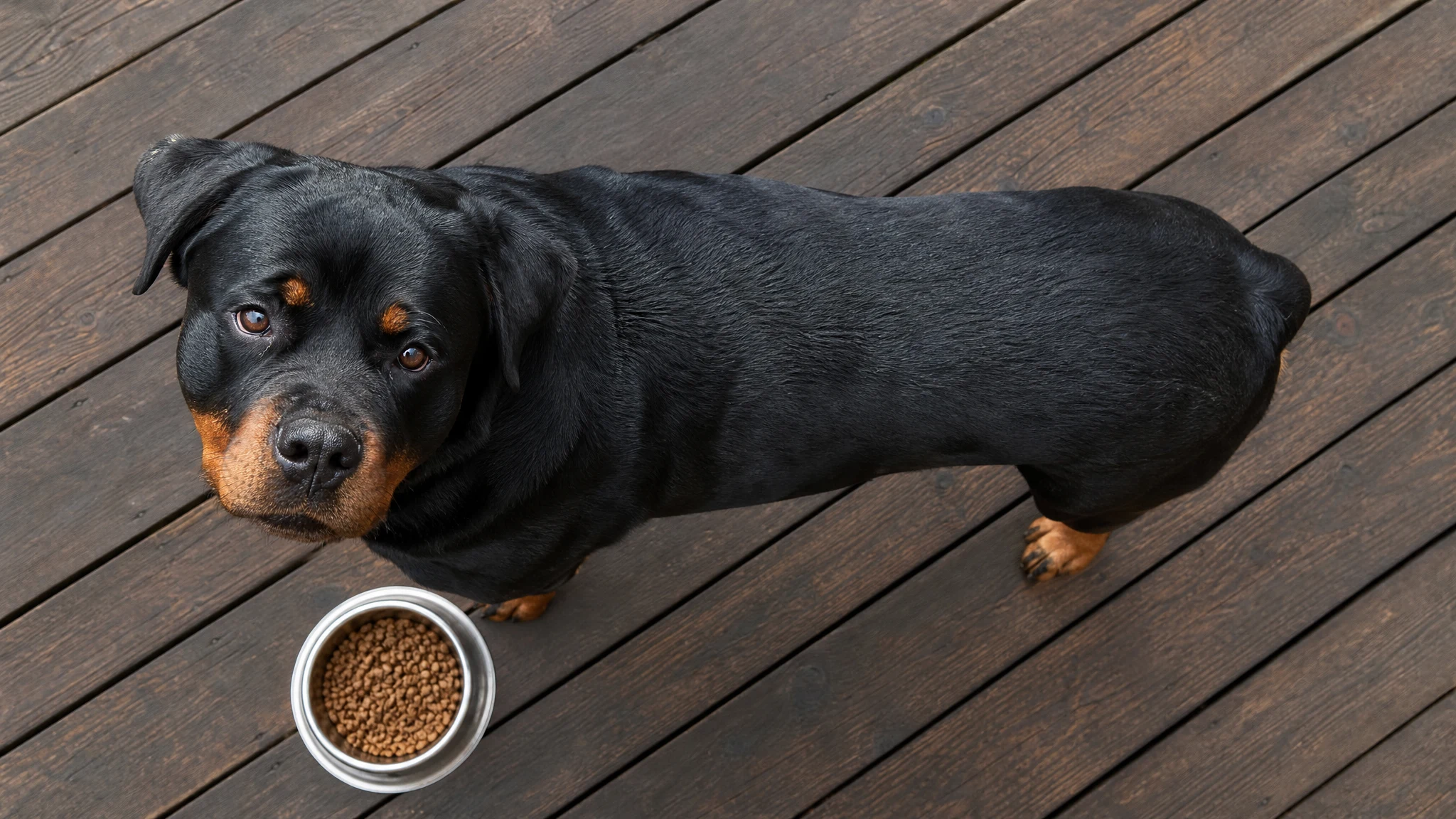
Rottweilers vary a lot in size. Hill's Pet Nutrition, on its Rottweiler breed page, gives an adult range of 80 to 135 pounds, with males usually heavier than females. A 85 pound female and a 130 pound male should not get the same scoop.
This guide shows how to use a rottweiler feeding chart by weight the right way. That means reading the chart on your own dog's food bag, treating it as a starting point, and adjusting from there. No chart can tell you the exact amount for your dog.
We compared label data and published feeding guides. We did not run feeding trials or taste tests.
What You Need
- A kitchen scale that weighs in grams or ounces. Hill's recommends measuring daily portions with a scale for Rottweilers.
- A standard measuring cup, if you also want a cup measure.
- The bag or can of your dog's current food, with the feeding guide and calorie statement.
- A bathroom scale or a vet's scale to get your dog's current weight.
- A notebook or phone note to log weight, portions and treats.
Step 1: Get Your Dog's Real Weight
Weigh your Rottweiler. The simplest way is to step on a bathroom scale holding your dog, then subtract your own weight. Many vet clinics also let you walk in and weigh your dog for free or a small charge. Ask the clinic.
Write the number down. Feeding charts are organized by weight, so a guess of "about 100" can be off by 15 pounds or more.
Step 2: Pick the Right Life Stage Formula
Weight is only one input. Age matters just as much.
Hill's says Rottweilers are considered adults at 12 to 18 months. It also says Rottweiler puppies benefit from a large-breed puppy formula, which is built for controlled bone and joint growth. Royal Canin's Rottweiler Puppy page says to switch to its Rottweiler Adult food after 18 months.
If your dog is still growing, the puppy chart is the one to use. Our guide to how much to feed a Rottweiler by age covers the puppy months in more detail.
Step 3: Read the Feeding Guide on Your Food
Each brand sets its own amounts, because foods differ in calories. The same dog needs fewer cups of a dense food and more cups of a lighter one.
Here are label starting points published by brands, for dogs in the Rottweiler size range:
| Food | Label calories | Published feeding example |
|---|---|---|
| Royal Canin Breed Health Nutrition Rottweiler Adult (dry) | 366 kcal ME per cup, as fed, calculated | Table covers 88 to 128 lb by activity. An 88 lb dog at low activity gets 4 cups (369 g) per day. 1 cup = 94 g. |
| Hill's Science Diet Adult Large Breed No Corn, Wheat, Soy Chicken & Brown Rice (dry) | 390 kcal per cup | 3 cups per day for 50 lb and 5 cups per day for 100 lb. Adjust to maintain optimal weight. |
| VICTOR Classic Elite Canine (dry) | 386 kcal per cup | Increase intake by 1/2 cup for every 20 lb over 100 lb. |
| Freshpet Chunky Chicken & Turkey roll (fresh, adult) | 304 kcal per 1/2 lb, calculated | 61 to 100 lb: 1 1/2 to 2 lb per day. 101 lb and over: 2 lb plus 1/4 lb per additional 25 lb beyond 100. |
| Hill's Science Diet Adult Chicken & Barley Entree (wet, 13 oz cans) | 368 kcal per can | Chart runs up to 6 cans per day for a 120 lb dog. |
Notice what the table does not give: a single number for every weight. The brands publish only some weights in the sources we read. For other weights, check the full chart on the brand's own page or the package.
Do not blend numbers from different foods. Royal Canin's 4 cups for an 88 lb dog and Hill's 5 cups for a 100 lb dog are not directly comparable. They are different foods with different calorie counts.
Some quick label arithmetic shows why. Four cups at 366 kcal is about 1,464 kcal. Five cups at 390 kcal is about 1,950 kcal. Those are different dogs on different foods, so the point is not which is right. The point is that the cup count means nothing without the calories behind it.
Step 4: Measure by Weight, Not by Scoop
A cup of kibble can vary by 10 to 20 percent depending on how you scoop it. For a large dog eating several cups a day, that error adds up fast.
Royal Canin's page gives the conversion for its Rottweiler Adult food: 1 cup is 94 g. Use grams from the guide and weigh each meal. If your food's page lists grams, use those. If it only lists cups, weigh your usual level cup once and write the grams on the bag.
Fresh foods are already portioned by weight. Freshpet's guide, for example, is written in pounds of roll per day.
Step 5: Split the Day Into Meals
The sources we reviewed give daily totals, and none of them fixes a meal schedule for Rottweilers. A common approach for large dogs is two meals a day, with the daily total divided between them. Ask your veterinarian whether that suits your dog, especially if your dog has had digestive trouble.
Whatever you choose, keep the schedule steady. Do not start the day's food at the daily total and then add a second full serving.
Step 6: Check Body Condition Every Two Weeks
The label amount is a start. Your dog's body tells you whether it is right.
- Run your hands along the ribs. You should be able to feel them without pressing hard.
- Look from above. There should be a visible waist behind the ribs.
- Look from the side. The belly should tuck up a little rather than hang level or sag.
Hill's notes that a lean body condition supports joint health in a breed prone to hip and elbow dysplasia. It also says reduced activity with age may lead to extra weight. Neither statement means a food or portion prevents a joint problem. It means extra weight is worth watching.
If your dog is gaining, reduce the daily amount in small steps and recheck in two weeks. If your dog looks thin, increase in small steps. Hill's feeding guides say to adjust amounts as necessary to maintain optimal weight. That is the same idea.
Step 7: Adjust for Activity and Age
Royal Canin's Rottweiler Adult table lists amounts by both weight and activity level. A dog that hikes or trains daily needs a different amount than one that mostly naps.
Older dogs often slow down. Hill's makes a separate Adult 6+ Large Breed food for dogs 6 years and over, at 352 kcal per cup. Its guide says to adjust amounts to maintain optimal weight, and to ask your veterinarian if you are unsure. Hill's puts the life expectancy of the Rottweiler at 9 to 10 years, so many owners reach the senior stage with years still ahead.
Puppies: Use Target Adult Weight and Age
Puppy charts work differently. Royal Canin's Rottweiler Puppy page bases its guide on the puppy's age and the expected adult weight. At 2 months, for a target adult weight of 88 lb, it lists 3 cups (293 g) per day.
Hill's Science Diet Puppy Large Breed says to adjust amounts as necessary to maintain optimal weight and to ask your veterinarian if you are unsure. Your vet can help you estimate a sensible target weight and track growth.
Tips and Common Mistakes
- Counting treats as free. Treats, chews and food used for training add calories. Subtract some from the bowl on heavy training days.
- Using the wrong chart. A puppy food chart and an adult food chart are not interchangeable. Neither are charts from different brands.
- Switching foods overnight. Mix the new food in gradually over several days, and ask your vet if your dog has a sensitive stomach.
- Ignoring the food's life stage statement. Look for the AAFCO statement. For example, Hill's wet adult entree is not for puppies, and JustFoodForDogs says its Beef & Russet Potato recipe is not intended for growing puppies.
- Feeding to the top of a weight range. If your dog is at 95 lb but should be 85 lb, ask your vet about a target weight. Feeding for the heavier number keeps the extra weight on.
- Adding supplements on your own. Do not guess at amounts. Ask your veterinarian before giving any supplement.
When to Call Your Veterinarian
Confirm amounts with your vet if your dog has a health condition, is underweight or overweight, is a puppy with uneven growth, or is on a prescription diet. Prescription diets are something only a veterinarian prescribes, and they come with their own feeding instructions.
This is also the right call if your dog has joint trouble. Hill's lists hip and elbow dysplasia as concerns in the breed. A veterinarian decides what is right for an individual dog, not a feeding chart.
What to Expect
If you weigh meals, track body condition and adjust slowly, you may find your dog stays closer to a lean, steady weight. Some owners see a change in two to four weeks, but dogs differ. Nothing here promises a particular result.
A good sign is a dog with a visible waist, easily felt ribs, steady energy and normal stools. If something looks off, contact your vet rather than changing the diet again.
Sources
- Hill's Pet Nutrition, Rottweiler breed page
- Royal Canin US, Breed Health Nutrition Rottweiler Adult
- Royal Canin US, Breed Health Nutrition Rottweiler Puppy
- Hill's Science Diet Adult Large Breed No Corn, Wheat, Soy
- Hill's Science Diet Puppy Large Breed
- Hill's Science Diet Adult 6+ Large Breed
- Hill's Science Diet Adult Chicken & Barley Entree (wet)
- VICTOR Classic Elite Canine
- Freshpet Chunky Chicken & Turkey roll
- JustFoodForDogs Beef & Russet Potato