Mixed Feeding for Rottweilers: Combining Wet and Dry Food
General nutrition information compiled from product labels and published sources, not veterinary advice. Your veterinarian is the right person to choose a diet for your dog, especially one with a health condition.
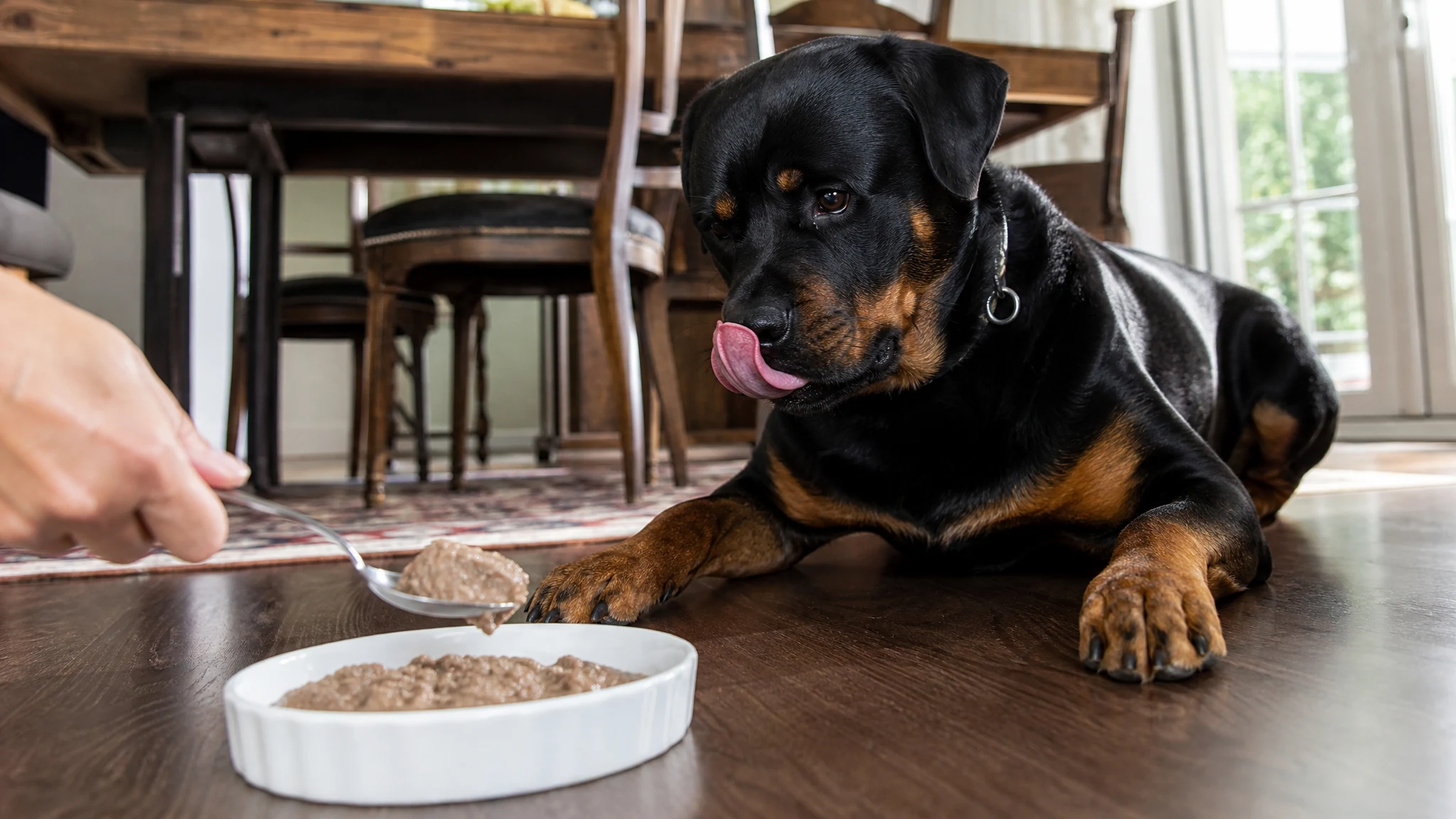
Mixed feeding means serving both dry kibble and wet food in the same day, or even the same bowl. Some owners do it to make meals more appealing. Others like the variety or the extra moisture.
The risk with a large breed is simple: calories add up fast. If you add a can on top of a full portion of kibble, you have fed more food, not mixed food. This guide shows how to combine the two while keeping the daily total in check.
Why Rottweiler owners should count calories first
Hill's Pet Nutrition, in its Rottweiler breed page, gives an adult weight range of 80 to 135 pounds. It also notes that reduced activity with age may lead to extra weight, and that lean body condition supports joint health. Hip and elbow dysplasia are listed there as common joint development problems in the breed.
That does not mean any food prevents or treats a joint problem. It means extra pounds are worth avoiding, and mixed feeding is an easy place for extra pounds to sneak in. Hill's suggests measuring daily portions with a kitchen scale, and that advice fits here.
Materials you will need
- A dry food and a wet food that both say they are complete and balanced for your dog's life stage.
- A kitchen scale, or a marked measuring cup if you must.
- A calculator and the calorie numbers from each label.
- A notebook or phone note to track portions and body condition.
- Your veterinarian's contact details, for any dog with a health condition.
How we compared the foods
We compared label data published by the brands. We did not run feeding trials or taste tests, and we have not fed these foods to dogs. The products below are examples of what the label numbers look like. They are not rankings or recommendations for your dog.
Step-by-step: how to combine wet and dry food
Step 1: Match both foods to your dog's life stage
Check the nutritional adequacy statement on each package. It should name your dog's stage: growth, adult maintenance, or all life stages.
Hill's says a Rottweiler reaches adulthood at 12 to 18 months, and that puppies benefit from a large-breed puppy formula with controlled bone and joint growth. So a puppy's wet food should also be made for growth. For example, the Hill's Science Diet Adult Chicken & Barley wet entree is labeled for adults and is not for puppies. A growing Rottweiler needs a wet food whose label says it covers growth, such as an all-life-stages food that names large dogs.
Step 2: Find the daily calorie target from the dry food's feeding guide
Start with the dry food's own feeding table, which is organized by weight and sometimes activity. Treat it as a starting point, not a prescription.
Some examples from the labels:
- Royal Canin Breed Health Nutrition Rottweiler Adult lists a daily table for dogs from 88 to 128 pounds. An 88 pound dog at low activity is listed at 4 cups per day, at 366 kcal per cup.
- Hill's Science Diet Adult Large Breed No Corn, Wheat, Soy Chicken & Brown Rice lists 5 cups per day for a 100 pound dog, at 390 kcal per cup, and says to adjust to maintain optimal weight.
- VICTOR Classic Elite Canine says to add 1/2 cup for every 20 pounds over 100 pounds, at 386 kcal per cup.
Multiply cups by kcal per cup to get a daily calorie figure. For the Hill's example, 5 cups at 390 kcal is about 1,950 kcal. For a broader look at amounts by age, see our Rottweiler feeding chart by age.
Step 3: Decide how much of the day the wet food will cover
Pick a share for the wet food. Many owners start small, such as one quarter of the daily calories, then adjust. This is a simple planning choice, not a rule from a source.
Then work out the calories. Using the Hill's example of about 1,950 kcal a day, a quarter is roughly 490 kcal from wet food and about 1,460 kcal from kibble.
Step 4: Convert the wet food into its own portion
Read the wet food's calories carefully. Wet food is often listed per can, not per cup. The Hill's Science Diet Adult Chicken & Barley entree lists 368 kcal per 13 ounce can. Its feeding chart runs from 1/2 can for a 5 pound dog up to 6 cans for a 120 pound dog, as a full-diet amount.
Fresh foods use other units. Freshpet lists its Vital Chicken roll at 309 kcal per 1/2 pound, and Nom Nom lists Beef Mash at 201 kcal per cup (calculated). Always use the number printed for the exact product you buy.
Step 5: Reduce the kibble to make room
This is the step people skip. Whatever calories the wet food adds, take the same amount out of the dry food.
Here is the arithmetic for one full can. A 13 ounce can at 368 kcal replaces roughly 368 divided by 390, or a little under 1 cup, of the Hill's large breed kibble. So if you add one can, you would trim a bit under a cup of that kibble. Use your own labels and your own numbers.
Step 6: Measure, then mix
Weigh or measure both parts at each meal. Stir the wet food through the kibble, or serve it on top. Check the kibble size on the brand page if your dog gulps, since the sources we used do not list kibble size for most of these foods.
Step 7: Transition gradually
Do not change everything on day one. Introduce the new food a little at a time over several days while the old food shrinks, and watch stool quality and appetite. If anything looks off, pause and call your veterinarian.
Step 8: Check body condition and adjust
Every two to four weeks, look at your dog's waist and feel the ribs. If your dog is gaining, trim the daily total slightly. If your dog is losing weight without a plan, add a little. Small changes are easier to judge than big ones.
Reading labels side by side
Wet food is mostly water, so you cannot compare its protein or fat to kibble directly. The Hill's wet entree lists water as its first ingredient, then chicken and pork liver. Hill's large breed dry lists chicken, brown rice and brewers rice first.
On a dry matter basis, which removes the water, Hill's gives average protein of 26.7 percent for the wet entree and 23.8 percent for the adult large breed dry food. Hill's labels these as averages, not guaranteed minimums. Freshpet's Vital Chicken roll lists a 9.5 percent protein minimum, but that is as fed, so it is not comparable to a dry matter figure.
Some foods are better suited to mixing than others. The table shows a few label details.
| Food | Form | Life stage on label | Calories on label |
|---|---|---|---|
| Royal Canin Rottweiler Adult | Dry | Adult, 18 months and older | 366 kcal per cup |
| Royal Canin Rottweiler Puppy | Dry | Growth, 8 weeks to 18 months | 358 kcal per cup |
| Hill's Science Diet Puppy Large Breed | Dry | Large breed puppy | 387 kcal per cup |
| Hill's Science Diet Adult Chicken & Barley Entree | Wet | Adult, 1 to 6 years | 368 kcal per 13 oz can |
| VICTOR Classic Hi-Pro Plus Large Breed Puppy | Dry | All life stages | 365 kcal per cup |
| Nom Nom Beef Mash | Fresh | All life stages, including large dogs | 201 kcal per cup |
Check the brand's own page for the full statement and current numbers before you buy. Some of the statements above are shortened here.
Tips for success
- Keep one variable at a time. Change the wet food or the amount, not both, so you can tell what affected your dog.
- Store opened cans properly. Follow the brand's storage directions for leftovers.
- Count treats and toppers. They are calories too.
- Stay with one wet recipe for a while. It makes portions and stool changes easier to track.
- Use the scale every time. A "scoop" of wet food can vary a lot.
Common mistakes to avoid
- Adding without subtracting. This is the most common way mixed feeding leads to weight gain.
- Using an adult wet food for a puppy. Large breed puppies need a growth statement on both foods.
- Comparing as fed and dry matter numbers. The percentages are not on the same footing.
- Treating a label guide as a fixed rule. Hill's, Royal Canin and others all say to adjust to keep your dog lean.
- Mixing in supplements without asking. Ask your veterinarian before adding anything to meals.
- Expecting food to fix a health problem. Diet is one piece. Your veterinarian decides what is right for an individual dog.
Expected results
If you keep the calorie total steady, many dogs adjust to mixed meals within a week or two. You may notice better interest in meals, and some owners find it easier to keep portions consistent. Results vary by dog, and a food change may not suit every dog.
A steady, lean body condition is the main thing to watch. Keeping a Rottweiler lean may support joint comfort, but it will not prevent hip or elbow dysplasia on its own.
If your dog has a health condition, such as a joint problem, a food sensitivity or a heart condition, confirm amounts and food choices with your veterinarian first. Prescription diets are only something a veterinarian prescribes. Do not swap one in or out yourself.
Quick recap
- Match both foods to your dog's life stage.
- Find the daily calories from the dry food's guide.
- Choose the wet food's share.
- Convert wet food using its own calorie number.
- Reduce the kibble by the same calories.
- Measure and mix.
- Transition gradually.
- Check body condition and adjust.
Sources
- Hill's Pet Nutrition, Rottweiler breed page
- Hill's Science Diet Adult Large Breed No Corn, Wheat, Soy Chicken & Brown Rice
- Hill's Science Diet Adult Chicken & Barley Entree wet food
- Hill's Science Diet Puppy Large Breed
- Royal Canin Breed Health Nutrition Rottweiler Adult
- Royal Canin Breed Health Nutrition Rottweiler Puppy
- VICTOR Classic Elite Canine
- VICTOR Classic Hi-Pro Plus Large Breed Puppy
- Freshpet Vital Chicken Recipe with Peas, Carrots & Brown Rice
- Nom Nom Beef Mash