Feeding a Rottweiler Dog: How Diet Affects Long-Term Health
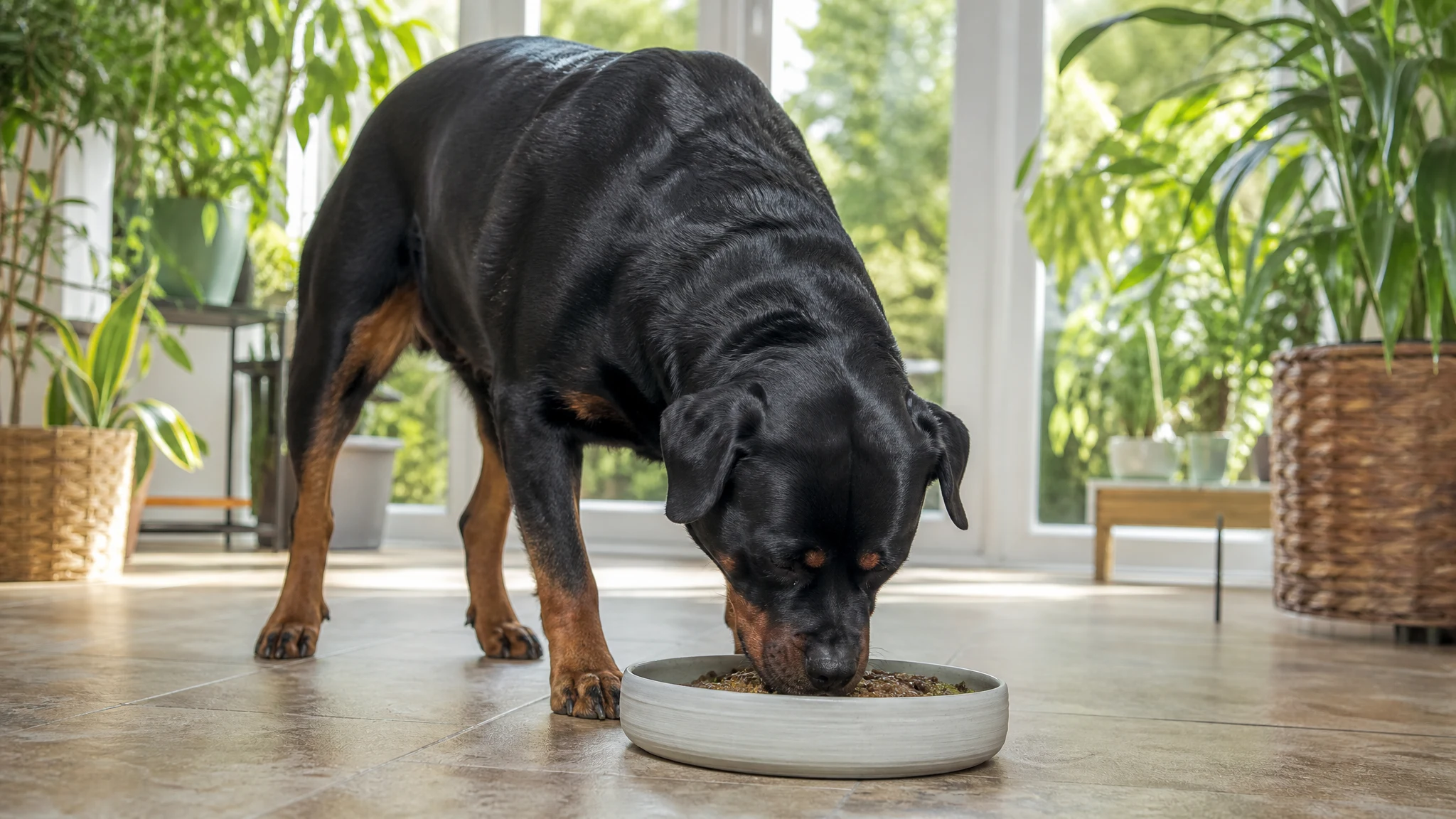
General nutrition information compiled from product labels and published sources, not veterinary advice. Your veterinarian is the right person to choose a diet for your dog, especially one with a health condition.
Diet will not decide your Rottweiler's whole health story. Genetics, exercise and veterinary care matter too. But food is the part you control every day, so it is worth getting right.
This guide walks through feeding a rottweiler dog step by step: what to gather, how to read a label, how to set a starting portion, and how to adjust over time. It is a label-reading guide. We compared published label data from brand pages. We did not run feeding trials or taste tests.
Why diet matters for this breed
Hill's Pet Nutrition, in its Rottweiler breed page, gives an adult weight of 80 to 135 pounds, with males usually heavier than females. It also gives a life expectancy of 9 to 10 years. A dog that size grows fast and carries a lot of weight on its joints.
The same Hill's page lists hip and elbow dysplasia as common joint development problems in Rottweilers. It says a lean body condition supports joint health. It also notes that reduced activity with age may lead to extra weight, and suggests measuring daily portions with a kitchen scale.
That is the core idea of this article. Food cannot cure or prevent these conditions. What you can do is keep your dog lean, feed the right life stage formula, and measure portions. Your veterinarian decides what is right for an individual dog.
What you will need
- A kitchen scale that weighs in grams or ounces
- A standard measuring cup, used only as a backup to the scale
- The bag, can or product page for the food you are considering
- A notebook or phone note to log weight and portions
- A dog food that states it meets AAFCO nutrient profiles for your dog's life stage
- Your veterinarian's contact details, for weight checks and any health question
Step 1: Identify your dog's life stage
Hill's says Rottweilers reach adulthood at about 12 to 18 months. Until then, a puppy needs a growth formula. The Hill's page recommends a large-breed puppy formula for Rottweiler puppies, with controlled bone and joint growth.
Royal Canin's Rottweiler Puppy page covers 8 weeks to 18 months and says to switch to its Rottweiler Adult formula after 18 months. Hill's describes its large-breed adult food for dogs aged 1 to 5 years and its Adult 6+ large-breed food for older dogs. Ask your veterinarian when to make each switch for your dog.
Step 2: Read the AAFCO statement first
Find the sentence that says the food is complete and balanced, and for which life stage. It will say maintenance, growth, or all life stages. A maintenance-only food is not meant for a growing puppy.
Some examples from the brands' own pages:
- Royal Canin Rottweiler Adult is formulated for maintenance.
- Royal Canin Rottweiler Puppy is formulated for growth.
- Freshpet's Vital Chicken Recipe says it is formulated for all life stages, including growth of large dogs (70+ lb as adults).
- JustFoodForDogs says its Beef & Russet Potato recipe is not intended for growing puppies.
For some products the full statement is longer than what the page shows. Check the actual label before you buy.
Step 3: Compare ingredients and numbers carefully
Look at the first five ingredients and the calories per cup. Be skeptical of front-of-bag claims. A picture of a roast chicken tells you nothing about the formula inside.
Here is a small comparison from the brands' own pages. Hill's protein and fat figures are average dry matter values, not guaranteed minimums, so they are not directly comparable to the guaranteed minimums for the others.
| Food | Life stage | First ingredients listed | Calories |
|---|---|---|---|
| Royal Canin Rottweiler Adult (dry) | Adult maintenance | Chicken by-product meal, chicken fat, brown rice, corn, brewers rice | 366 kcal ME per cup |
| Royal Canin Rottweiler Puppy (dry) | Growth | Chicken by-product meal, brewers rice, wheat gluten, brown rice, chicken fat | 358 kcal ME per cup |
| Hill's Science Diet Adult Large Breed (dry) | Adult maintenance | Chicken, brown rice, brewers rice, cracked pearled barley, chicken meal | 390 kcal per cup |
| Hill's Science Diet Puppy Large Breed (dry) | Growth | Chicken, brown rice, whole grain oats, chicken meal, cracked pearled barley | 387 kcal per cup |
| VICTOR Classic Elite Canine (dry) | All life stages | Chicken meal, whole grain brown rice, grain sorghum, peas, chicken fat | 386 kcal per cup |
Royal Canin lists a guaranteed minimum of 24% protein and 18% fat for the adult formula, and 29% protein and 14% fat for the puppy formula. VICTOR's Classic Elite Canine lists 25% protein and 14% fat as minimums. Hill's lists dry matter averages of 23.8% protein and 16.3% fat for its adult large-breed food.
None of these numbers tells you which food is best for your dog. They tell you how the foods differ so you can ask better questions. Kibble size was not listed on the pages we compared, so check with the brand if it matters for your dog.
Fresh and wet foods are on the list too. Freshpet, JustFoodForDogs, Nom Nom and Hill's wet food publish their own label data. Their calories are given per can, per pound or per kilogram, so a cup-to-cup comparison with kibble does not work. Check each brand's page for its feeding guide.
Step 4: Set a starting portion
Use the feeding guide on the product as a starting point, not a final answer. Examples from the brands' pages:
- Royal Canin Rottweiler Adult: its table lists 4 cups (369 g) per day for an 88 lb dog at low activity. The page defines 1 cup as 94 g.
- Royal Canin Rottweiler Puppy: 3 cups (293 g) per day at 2 months for a puppy with a target adult weight of 88 lb.
- Hill's Science Diet Adult Large Breed: 3 cups per day for a 50 lb dog and 5 cups per day for a 100 lb dog, adjusted to maintain optimal weight.
- VICTOR Classic Elite Canine: add 1/2 cup for every 20 lb over 100 lb.
These foods have different calorie densities, so the same cup count means different calories. Weigh the portion on a scale in grams. Cups vary with how the kibble settles.
For a size and age breakdown, see our guide to how much to feed a Rottweiler by age.
Many owners split the daily amount into more than one meal. Ask your veterinarian which schedule suits your dog.
Step 5: Check body condition every few weeks
Weigh your dog on a regular schedule and write it down. Many vets use a body condition score, and your clinic can show you how to check it at home. You are looking for a visible waist from above and ribs you can feel without pressing hard.
If your dog is gaining, trim the portion slightly and check again. If your dog is losing weight without a plan, call your veterinarian rather than just adding food.
Step 6: Adjust as your dog ages
Hill's notes that activity often drops with age and extra weight can follow. The foods you chose at 2 years may need to change by 6 or 7 years. Hill's makes an Adult 6+ large-breed formula at 352 kcal per cup, which is lower than its regular large-breed adult food at 390 kcal per cup. Whether that fits your dog is a question for your veterinarian.
Change foods slowly. Mixing the new food in with the old over several days is a common approach. Ask your vet for the pace that suits your dog.
Common mistakes to avoid
- Feeding an adult formula to a puppy, or the reverse. Match the AAFCO statement to the life stage.
- Trusting the cup alone. Weigh the food instead.
- Ignoring treats. They add calories. Count them in the day's total.
- Letting a puppy grow too fast. The Hill's breed page points to large-breed puppy formulas for controlled bone and joint growth.
- Judging by marketing words. Terms like premium or natural are not a substitute for the AAFCO statement and the ingredient list.
- Assuming grain-free means better. Of the foods compared here, only JustFoodForDogs Beef & Russet Potato is listed as grain-free. Talk to your veterinarian before choosing a diet on that basis.
- Changing foods suddenly. Gradual changes are easier on most dogs.
What to expect
Over several months, a well-matched diet with measured portions may help your Rottweiler hold a lean, steady weight. A lean dog puts less load on its joints, which the Hill's page links to joint health. Many owners also notice steadier energy and consistent stools, though every dog differs.
No food can promise to prevent hip or elbow dysplasia, heart disease or any other condition. The Hill's page lists subaortic stenosis as a severe inherited heart disease, and it is not described there as something diet manages. If your dog has a health condition, confirm food and amounts with your veterinarian. Prescription diets are available only from a veterinarian.
Quick checklist
- Confirm your dog's life stage (puppy until about 12 to 18 months, then adult).
- Choose a food with an AAFCO statement for that stage.
- Compare ingredients and calories on the brand's own page.
- Weigh a starting portion from the label guide.
- Track weight and body condition every few weeks.
- Adjust slowly and check with your veterinarian.
Sources
- Hill's Pet Nutrition, Rottweiler breed page
- Royal Canin, Rottweiler Adult product page
- Royal Canin, Rottweiler Puppy product page
- Hill's Science Diet, Adult Large Breed product page
- Hill's Science Diet, Puppy Large Breed product page
- Hill's Science Diet, Adult 6+ Large Breed product page
- VICTOR, Classic Elite Canine product page
- Freshpet, Vital Chicken Recipe product page
- JustFoodForDogs, Beef & Russet Potato product page