Dog Feeding Chart Basics: How to Read One Correctly
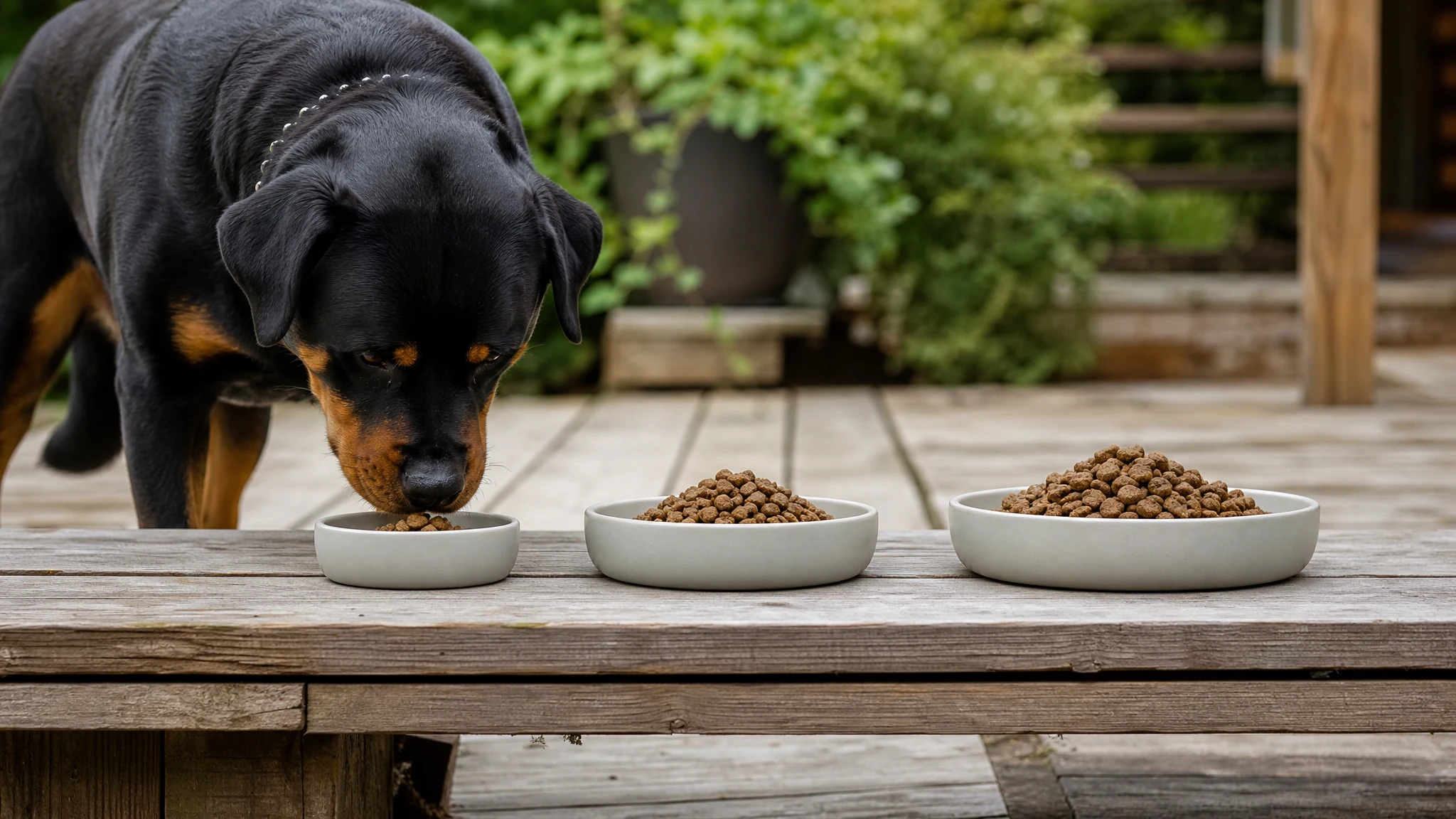
General nutrition information compiled from product labels and published sources, not veterinary advice. Your veterinarian is the right person to choose a diet for your dog, especially one with a health condition.
A dog feeding chart looks simple. You find your dog's weight, read across, and scoop. With a Rottweiler, it is easy to misread, because the chart on one bag does not match the chart on another.
Adult Rottweilers usually weigh 80 to 135 pounds, according to Hill's Pet Nutrition's Rottweiler breed page. That range is wide, and many charts split it into different rows. This guide shows you how to read a chart step by step, what to watch for, and when to call your veterinarian.
One note on method. We compared label data and published feeding guides. We did not run feeding trials or taste tests, and the amounts below are examples of what labels say, not recommendations for your dog.
What You Need Before You Start
- The food bag, can or package, with the feeding guide and the nutrition panel visible
- Your dog's current weight, taken recently (a vet visit or a home scale)
- Your dog's age in months if under two years
- A kitchen scale and a standard measuring cup
- A note of your dog's usual activity level
- A notebook or phone note to track weight and body condition
Step 1: Find the Life-Stage Statement First
Before you look at any numbers, find the AAFCO statement on the package. It says which life stage the food is built for, such as growth, adult maintenance or all life stages. A chart only makes sense for the dog the food was made for.
For example, Hill's lists its Science Diet Adult Large Breed Chicken & Brown Rice recipe for adult maintenance. Its Puppy Large Breed recipe is for growth. Feeding the wrong one means the chart you are reading does not apply to your dog.
Rottweiler puppies benefit from a large-breed puppy formula, according to Hill's breed page. The same page says a Rottweiler is considered an adult at 12 to 18 months. Royal Canin's Rottweiler Puppy page covers 8 weeks to 18 months and says to switch to its Rottweiler Adult formula after 18 months. Check the brand page or ask your vet about when to switch.
Step 2: Use the Right Weight Column
Most charts have a weight column. Some use the dog's current weight. Puppy charts often use the expected adult weight instead, and that changes everything.
Royal Canin's Rottweiler Puppy page gives an example. At 2 months, for a target adult weight of 88 pounds, it lists 3 cups (293 g) per day. Read the column headings closely. If you use current weight in a column built for adult weight, you will feed the wrong amount.
For adults, use today's weight, not the weight you wish your dog was. If your dog is overweight, ask your vet which target weight to feed toward.
Step 3: Check the Unit (Cups, Grams, Cans or Pounds)
Charts use different units, and a cup is not a fixed amount of food. Royal Canin's adult page states that 1 cup equals 94 g. A cup of another food may weigh more or less.
Other foods use other units. Hill's wet Adult Chicken & Barley entree lists amounts in cans, from 1/2 can for a 5 pound dog to 6 cans for a 120 pound dog. Freshpet's guides use pounds of roll, for example 2 pounds plus 1/4 pound per additional 25 pounds over 100 for its Vital Chicken recipe.
Whatever the unit, weigh a few scoops on your kitchen scale once. Hill's breed page recommends measuring daily portions with a kitchen scale. Then you know what your cup really holds.
Step 4: Compare Calories, Not Just Cups
Two foods can both say "4 cups" and deliver very different calories. Look for the kcal per cup (or per can or kilogram) on the package or brand page.
| Food (dry) | Calories listed | Chart example from the brand |
|---|---|---|
| Royal Canin Rottweiler Adult | 366 kcal ME per cup | 88 lb, low activity: 4 cups (369 g) |
| Hill's Science Diet Adult Large Breed Chicken & Brown Rice | 390 kcal per cup | 3 cups for 50 lb, 5 cups for 100 lb |
| VICTOR Classic Elite Canine | 386 kcal per cup | Add 1/2 cup for every 20 lb over 100 lb |
The gap between 366 and 390 kcal per cup looks small. Over a full day of several cups, it adds up. If you switch foods, do not carry the old cup count over. Read the new chart from the start.
The Freshpet and Nom Nom pages list calories per kilogram, per half pound or per cup of a very different texture. Fresh foods are mostly water, so a pound of fresh food is not comparable to a pound of kibble.
Step 5: Factor In Activity Level
Some charts add an activity column. Royal Canin's adult table lists amounts by weight (88 to 128 lb) and activity. The 4 cups for an 88 lb dog applies to low activity. A more active dog would be read in a different column.
Be honest about activity. A Rottweiler who gets two short walks a day is not the same as one doing daily training work. Hill's breed page notes that reduced activity with age may lead to extra weight, so revisit your choice of column as your dog slows down.
Step 6: Treat the Chart as a Starting Point
Every chart is an average. Hill's own guides say to adjust feeding amounts as necessary to maintain optimal weight. Treat the number as the first scoop, not the final answer.
For the whole picture by life stage, see our guide to a Rottweiler feeding chart by age.
Step 7: Check Body Condition and Adjust
Every two to four weeks, weigh your dog and feel the ribs. You should be able to feel them under a thin layer of padding without pressing hard. Look from above for a waist.
Hill's breed page notes that hip and elbow dysplasia are common joint problems in Rottweilers and that a lean body condition supports joint health. That is a reason to keep a close eye on weight. It is not a promise that any food or portion will prevent a joint problem.
If your dog is gaining, trim the amount a little and recheck in a few weeks. If your dog is losing weight without a plan, talk with your vet before increasing food.
Step 8: Split the Daily Amount Into Meals
Most charts give a total for the day, not per meal. Divide the daily amount by the number of meals you feed. How many meals suits your dog, especially a puppy, is a question for your veterinarian, since the labels we compared do not set one schedule.
Count treats and chews too. If you give a lot of treats, you may need to reduce meals slightly. Ask your vet how much room to leave.
Common Mistakes to Avoid
- Using a puppy chart for an adult dog, or the reverse. Check the life-stage statement first.
- Mixing up current and adult weight. Puppy tables often use the expected adult weight.
- Assuming all cups are equal. Weigh your scoop and compare calories.
- Reading the chart for a different size dog. Hill's wet food chart runs to 120 lb and covers all adult sizes, so it is not built around a Rottweiler.
- Never rechecking. Weight changes with age and activity.
- Counting the bowl but not the extras. Treats, table scraps and training rewards all add calories.
- Switching foods suddenly. Ask your vet how to transition gradually.
Tips for Reading Charts Without Marketing Noise
- Read the guaranteed analysis and the first ingredients, but do not decide on those alone. The chart and the calories matter just as much.
- A "large breed" label is a starting point. Check that the weight range on the chart actually reaches your dog.
- Be careful with foods that are "all life stages." The VICTOR Classic Hi-Pro Plus Large Breed Puppy page lists an all-life-stages statement, so check the full label for the growth wording.
- If a label is vague about something, such as kibble size, check with the brand.
What to Expect
If the chart suits your dog, you may see steady weight, a visible waist and consistent energy over a few weeks. Results vary from dog to dog, and no chart can promise a particular outcome.
Some dogs need more or less than the chart suggests. That does not mean the chart is wrong. It means your dog's own body is the better guide.
When to Check With Your Vet
Confirm amounts with your veterinarian if your dog has a health condition, is a growing puppy, is a senior, or is losing or gaining weight quickly. Diet and joint health are linked in breed sources, but a veterinarian decides what is right for an individual dog. Any prescription diet comes only from a veterinarian.
Do not add supplements to "fix" a chart. Ask your vet first.
Sources
- Hill's Pet Nutrition, Rottweiler breed page
- Royal Canin, Rottweiler Adult product page
- Royal Canin, Rottweiler Puppy product page
- Hill's Science Diet, Adult Large Breed product page
- Hill's Science Diet, Adult Chicken & Barley wet food product page
- VICTOR, Classic Elite Canine product page
- VICTOR, Classic Hi-Pro Plus Large Breed Puppy product page
- Freshpet, Vital Chicken Recipe product page