Grain-Free Food and Rottweilers: What the FDA DCM Investigation Found
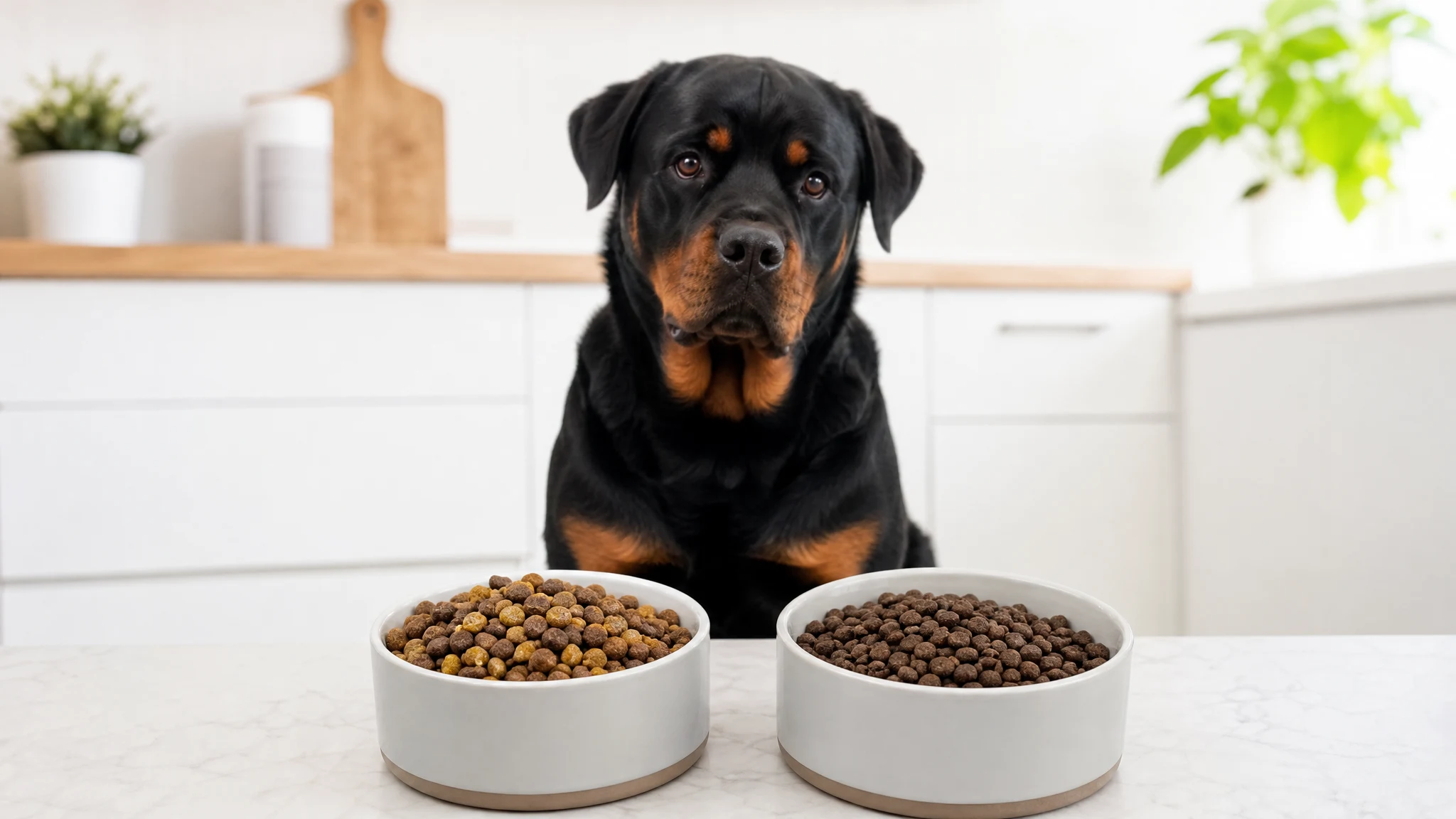
General nutrition information compiled from product labels and published sources, not veterinary advice. Your veterinarian is the right person to choose a diet for your dog, especially one with a health condition.
Many Rottweiler owners have heard that grain free dog food and DCM (dilated cardiomyopathy, a heart muscle disease) might be linked. The question "is grain free bad for Rottweilers" deserves a careful answer, not a scare.
This guide is a step-by-step way to look at your own dog's food, read the label, and prepare for a talk with your veterinarian. It does not tell you to switch foods, and it does not claim any food prevents or causes heart disease in an individual dog.
One honest limit first. The FDA Center for Veterinary Medicine (CVM) runs the DCM investigation, and its findings and status have been updated over time. We could not verify the current wording of those updates for this page, so we do not quote its numbers or conclusions here. Step 2 shows you where to read the latest directly from the agency.
What you need before you start
- The bag, can or roll your Rottweiler eats now, or a clear photo of the whole label.
- Your dog's current weight and age.
- A list of everything your dog eats: main food, toppers, treats, chews and any supplements.
- A pen and paper, or a notes app, for questions.
- A kitchen scale, which Hill's Pet Nutrition suggests for measuring daily portions.
- About 30 minutes to read, plus a visit or call with your veterinarian.
Step 1: Find out what "grain free" means on your label
"Grain free" only describes what is left out. It says nothing on its own about protein quality, calories or balance.
Look at the ingredient list, which is ordered by weight before cooking. Check whether it names corn, wheat, rice, barley, oats or sorghum. If none appear and the food replaces them with peas, lentils, chickpeas or potatoes, the food is grain free in practice.
A food can also be grain inclusive and still contain peas or other legumes. For example, the first five ingredients of VICTOR Classic Elite Canine are chicken meal, whole grain brown rice, grain sorghum, peas and chicken fat, and the label data lists it as not grain free. So the presence of a pea does not make a food grain free, and the absence of one does not settle anything.
Write down your food's first five ingredients and whether it contains grain. That note will be useful in Step 4.
Step 2: Read the FDA's latest DCM update yourself
Go to the FDA Center for Veterinary Medicine's page on canine dilated cardiomyopathy and diet. Read the most recent update, and note its date.
When you read it, look for these things:
- What the agency says it has and has not established about diet and DCM.
- Whether it names ingredients, food types or both as areas of concern, and how strongly it words that.
- What it says about other factors, such as genetics, and about how reports are collected.
- What it recommends owners do, and when it suggests contacting a veterinarian.
Be careful with older articles and social posts. The investigation has been updated more than once, and summaries often lag behind or exaggerate. The agency's own page is the authority here, and it can change.
Step 3: Check what is known about Rottweilers specifically
This is where owners most often get confused. The question is whether the breed has a stated DCM predisposition, and the sources we could verify do not answer it for Rottweilers.
Hill's Pet Nutrition's Rottweiler breed page lists hip and elbow dysplasia and weight gain as health topics tied to diet. It also lists subaortic stenosis (SAS), described as a severe inherited heart disease that the American Rottweiler Club is working to eradicate. That page does not describe SAS as diet managed, and it is a different condition from DCM.
We found no statement on that page linking Rottweilers to DCM. That is not proof that no link exists. It only means we cannot tell you one way or the other. Ask your veterinarian, and check the American Rottweiler Club's health information.
So "is grain free bad for Rottweilers" cannot be answered with a flat yes or no here. What you can do is take the steps below and let your veterinarian weigh your dog's own history.
Step 4: Look at the whole label, not one word
Whatever the grain question turns out to be, a few label checks matter for a large breed. Hill's puts adult Rottweilers at about 80 to 135 pounds, with adulthood arriving at 12 to 18 months.
- The AAFCO statement. Look for wording that the food is complete and balanced for your dog's life stage. Some Rottweiler puppy foods, such as Royal Canin's Rottweiler Puppy formula, say the food meets AAFCO Dog Food Nutrient Profiles for growth. Read the full statement on your own bag.
- Life stage match. Hill's advises a large-breed puppy formula for Rottweiler puppies, with controlled bone and joint growth. Adult and puppy foods are not interchangeable.
- Guaranteed analysis. Note the minimum protein and fat and the maximum fiber. Some brands publish dry matter averages instead, and those are not the same as guaranteed minimums.
- Calories per cup. The foods we compared range from about 352 to 390 kcal per cup for dry formulas. Calorie density matters for weight, and weight matters for joints.
- Feeding guide. Treat it as a starting point and adjust to your dog's body condition. Hill's says reduced activity with age may lead to extra weight.
Step 5: Compare against other foods by label data
If you want to see how different foods read side by side, our comparison of Rottweiler foods by label data lays out the ingredients, analysis and calories.
To be clear about method, we compared label data published by the brands. We did not run feeding trials or taste tests, and a comparison table cannot say what is right for your dog.
In that set, nearly every food is listed as not grain free. The exception is JustFoodForDogs Beef & Russet Potato, a fresh frozen adult recipe that is listed as grain free and is not intended for growing puppies. For Nom Nom Beef Mash, we could not confirm a grain free status, so check with the brand.
Grain inclusive does not mean better, and grain free does not mean worse. The list simply shows that the grain label is one of many details.
Step 6: Take your notes to your veterinarian
Bring your label notes, your list of treats and toppers, and the FDA page you read. Then ask:
- Does my Rottweiler's age, history or family background change how you think about diet and heart health?
- Is my current food a good match for his or her life stage and weight?
- Do you recommend any heart screening, and how often?
- If we change foods, how should we transition, and what signs should I watch for?
Your veterinarian decides what is right for an individual dog. If a diet change is ever advised for a medical reason, that decision belongs to them, including any prescription diet.
Tips
- Take a photo of the full label, including the AAFCO statement and the best-by code, before you throw out a bag.
- Check the date on any FDA update you read, and check again before you make a decision.
- Weigh your dog's food on a scale. Cups vary a lot from scoop to scoop.
- If you do change food, go gradually unless your veterinarian says otherwise.
- Keep a short log of your dog's weight, appetite, energy and stool, so that your vet has real data to look at.
Common mistakes to avoid
- Switching suddenly out of fear. An abrupt change can upset digestion, and it may not solve anything.
- Judging by one ingredient. Peas, grains and potatoes are only part of the picture.
- Trusting headlines over the source. Read the agency's own page.
- Mixing up SAS and DCM. They are different heart conditions.
- Adding supplements on your own. Ask your veterinarian first, and do not guess at doses.
- Feeding a puppy adult food. Rottweiler puppies need a growth formula suited to large breeds.
- Ignoring symptoms. Unusual tiredness, coughing, fainting or trouble breathing are reasons to call your veterinarian promptly, whatever your dog eats.
What to expect
After these steps you should have a clearer picture of what is in your dog's bowl and what the FDA currently says. You may also find that your veterinarian is comfortable with your current food, or suggests a change. Either result is possible.
Reading a label cannot tell you whether your dog will or will not develop a heart condition. Rottweilers live about 9 to 10 years according to Hill's, so steady weight management and regular checkups are practical ways to look after a dog's health over that time. Results vary from dog to dog.
Sources
- Hill's Pet Nutrition, Rottweiler breed page
- VICTOR Classic Elite Canine product page
- Royal Canin Rottweiler Puppy product page
- JustFoodForDogs Beef & Russet Potato product page
- Nom Nom Beef Mash product page
For the latest DCM findings, read the FDA Center for Veterinary Medicine's page on canine dilated cardiomyopathy directly. For breed health information, check with the American Rottweiler Club.