Best Fresh Food for Rottweilers: What to Check Before Switching
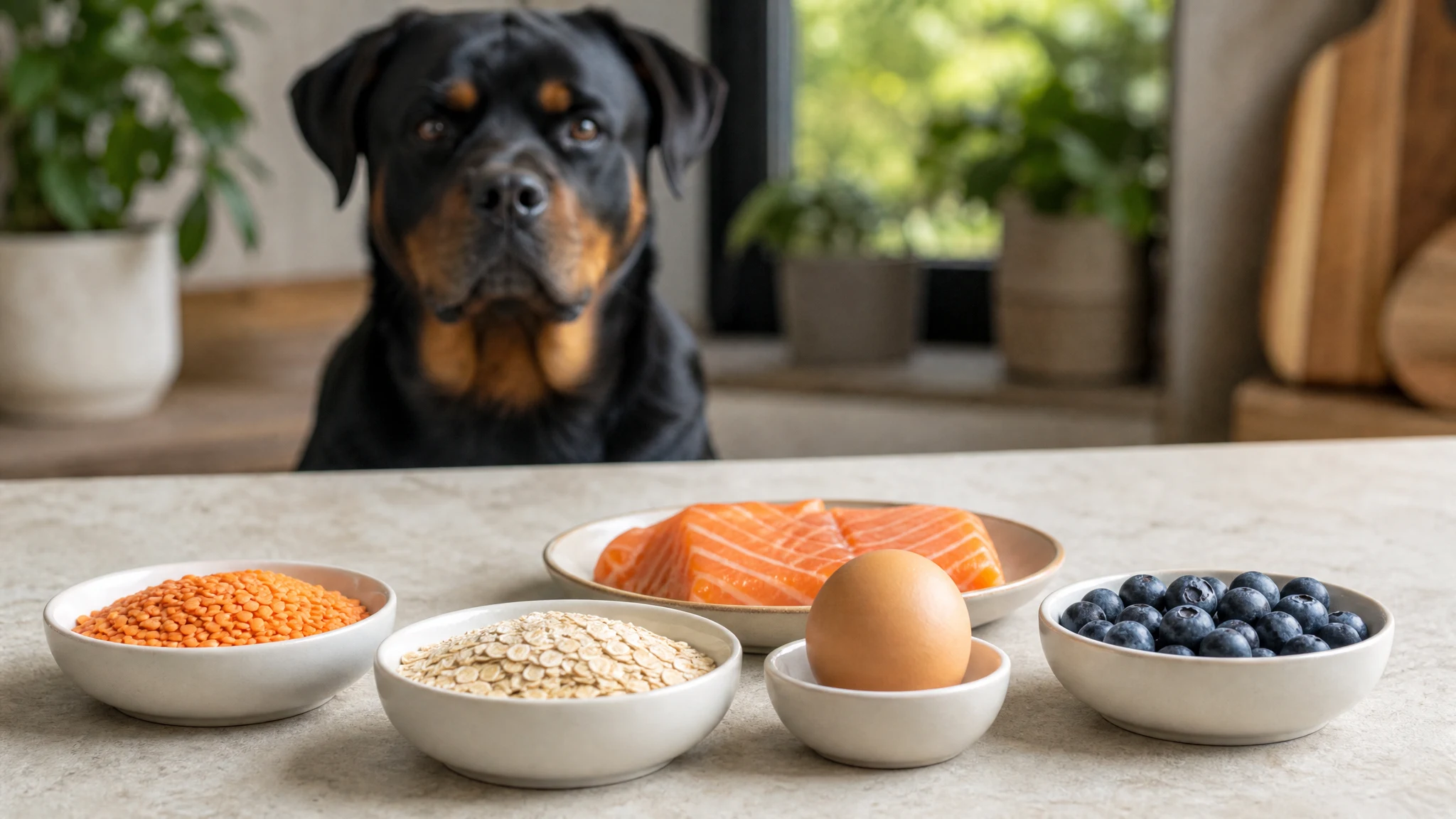
General nutrition information compiled from product labels and published sources, not veterinary advice. Your veterinarian is the right person to choose a diet for your dog, especially one with a health condition.
Fresh dog food looks appealing in the fridge case. Real chicken, carrots and brown rice read better than a list of meals and by-products. But a nice-looking label does not tell you whether a recipe fits a Rottweiler.
This guide walks you through the label checks that matter. It uses four fresh foods as examples: two from Freshpet, one from JustFoodForDogs and one from Nom Nom. The aim is to help you judge any fresh recipe, not to crown a winner.
A note on method. We compared label and product-page data only. We did not run feeding trials or taste tests, and we are not ranking foods by how dogs responded to them.
What you need before you start
- Your dog's current weight and age, ideally from a recent vet visit.
- The bag or tub of the food your dog eats now, so you can compare calories.
- The product page or package of each fresh recipe you are considering.
- A kitchen scale. Hill's Pet Nutrition, on its Rottweiler breed page, advises measuring daily portions this way.
- Fridge or freezer space. Fresh recipes are refrigerated or frozen, and the brand's storage directions apply.
- A list of questions for your veterinarian.
Step 1: Match the food to your Rottweiler's life stage
Hill's says adult Rottweilers weigh about 80 to 135 pounds, with males usually heavier than females. The same page says they reach adulthood at 12 to 18 months. That is a large dog with a long growing period, so life stage matters more than usual.
Look for the AAFCO statement on the label or product page. It tells you which stage the food was built for:
- Adult maintenance only. The Freshpet Chunky Chicken & Turkey roll is listed for adult maintenance. The JustFoodForDogs Beef & Russet Potato recipe is also adult maintenance, and its page says it is not intended for growing puppies.
- All life stages. The Nom Nom Beef Mash and the Freshpet Vital Chicken Recipe with Peas, Carrots & Brown Rice are both listed for all life stages. Both pages say this includes growth of large dogs, meaning 70 pounds or more as adults.
If you have a puppy, that large-dog growth wording is the line to look for. Hill's notes that Rottweiler puppies benefit from a large-breed puppy formula with controlled bone and joint growth. Ask your veterinarian whether a given fresh recipe suits your puppy before you buy it.
Step 2: Read the first five ingredients
The first ingredients show what the recipe is mostly made of by weight. Fresh foods list water-rich ingredients first, so keep that in mind. Here is what the brand pages show:
- Freshpet Vital Chicken: chicken, chicken liver, peas, carrots, chicken broth.
- Freshpet Chunky Chicken & Turkey: chicken, turkey, chicken liver, carrots, chicken broth.
- JustFoodForDogs Beef & Russet Potato: beef, beef liver, russet potatoes, sweet potatoes, carrots.
- Nom Nom Beef Mash: ground beef, russet potatoes, eggs, carrots, peas.
Do not read too much into any single ingredient. A short, familiar list is easy to follow, but it does not prove a recipe is better for your dog. The JustFoodForDogs page marks that recipe as grain free. The Nom Nom page does not give a clear grain-free answer, so check with the brand if that matters to you.
Step 3: Compare calories, not just cups
Calories drive weight, and weight matters for Rottweilers. Hill's lists hip and elbow dysplasia among the joint concerns in the breed and says a lean body condition supports joint health. It also warns that less activity with age can lead to extra weight.
No food prevents or treats dysplasia. What you can control is how much your dog eats. The calorie units on fresh labels vary, which makes comparison harder:
- Nom Nom Beef Mash: 201 kcal per cup, calculated.
- Freshpet Vital Chicken: 309 kcal per half pound.
- Freshpet Chunky Chicken & Turkey: 304 kcal per half pound.
- JustFoodForDogs Beef & Russet Potato: 792 kcal ME per 18 ounce pack.
For comparison, Royal Canin's Rottweiler Adult dry food lists 366 kcal per cup. A cup of dry food and a cup of fresh food are not the same amount of energy. Convert everything to calories per day, or weigh the food in ounces or grams, before you decide a swap is even.
Step 4: Understand the nutrient numbers fairly
The pages list minimum protein and fat and maximum fiber for the fresh recipes. For example, the Freshpet Vital Chicken roll lists 9.5 percent protein and 7 percent fat. The Nom Nom Beef Mash lists 8 percent protein and 5 percent fat.
Those figures look low next to a dry kibble. Royal Canin's Rottweiler Adult, for instance, lists 24 percent protein minimum. The gap is mostly water. Fresh food is moist, and dry food is not. Numbers on an as-fed basis from foods with different moisture cannot be compared directly. The brand can supply a dry matter figure on request, and your veterinarian can help interpret it.
Step 5: Find the feeding guide and treat it as a starting point
Feeding guides are written for an average dog. Your Rottweiler may need more or less. Here are examples from the brand pages:
- Freshpet Chunky Chicken & Turkey: 1 1/2 to 2 pounds per day for dogs 61 to 100 pounds. For dogs over 100 pounds, 2 pounds plus 1/4 pound for each additional 25 pounds.
- Freshpet Vital Chicken: the same 101-plus pound rule appears on its page.
- JustFoodForDogs: the page offers a feeding calculator but no fixed amount.
- Nom Nom: the page points to its Daily Feeding Guide for a full-meal diet.
Start there, then adjust by watching your dog's body condition and weight over several weeks. If you are unsure, ask your veterinarian to score your dog's body condition and set a daily calorie target.
Step 6: Weigh the practical side
Check the brand's own page for how the food is delivered, stored and served. Freshpet's page tells you to slice the roll at the serving marks and cut it into cubes of an inch or smaller. That detail matters for a big dog that gulps. Prices and plans change, so confirm current costs with the brand. We do not list any here.
Step 7: Switch gradually and ask your vet first
Talk to your veterinarian before changing diets, especially if your dog has a medical condition. A veterinarian decides what is right for an individual dog, and prescription diets come only from a vet.
When you start, mix a little of the new food into the old and increase it slowly. Follow the brand's transition directions and your vet's advice on timing. Weigh the portions each time.
For a wider view of what shapes a Rottweiler's bowl, see our guide to Rottweiler nutrition and the diet factors that matter.
Common mistakes to avoid
- Feeding an adult-only recipe to a puppy. Check the AAFCO life stage wording first.
- Swapping cup for cup. Fresh and dry foods carry different calories per cup.
- Comparing protein percentages across moisture levels. The numbers are not on the same footing.
- Switching all at once. A sudden change can upset some dogs' stomachs.
- Skipping the scale. Eyeballing portions is how extra weight sneaks in.
- Trusting front-of-bag claims. Words like fresh, natural or human grade are not a substitute for the AAFCO statement.
What results to expect
Results vary from dog to dog. Some owners find their dog is more interested in meals. Some see changes in stool or coat. Others see no difference. A well-matched food may help you keep your dog at a lean, healthy weight when portions are measured, but no food is a treatment for any condition.
Give any change a few weeks, track weight and stool quality, and report anything unusual such as vomiting, diarrhea or itching to your veterinarian.
So what is the best fresh food for Rottweilers?
There is no single answer. The best fresh food for Rottweilers is the one that matches your dog's life stage, fits a measured calorie target, comes with an AAFCO statement you understand and suits your vet's advice. Use the steps above to narrow your list, then confirm details with the brand and your veterinarian.