Best Training Treats for Rottweilers (and How Many to Give)
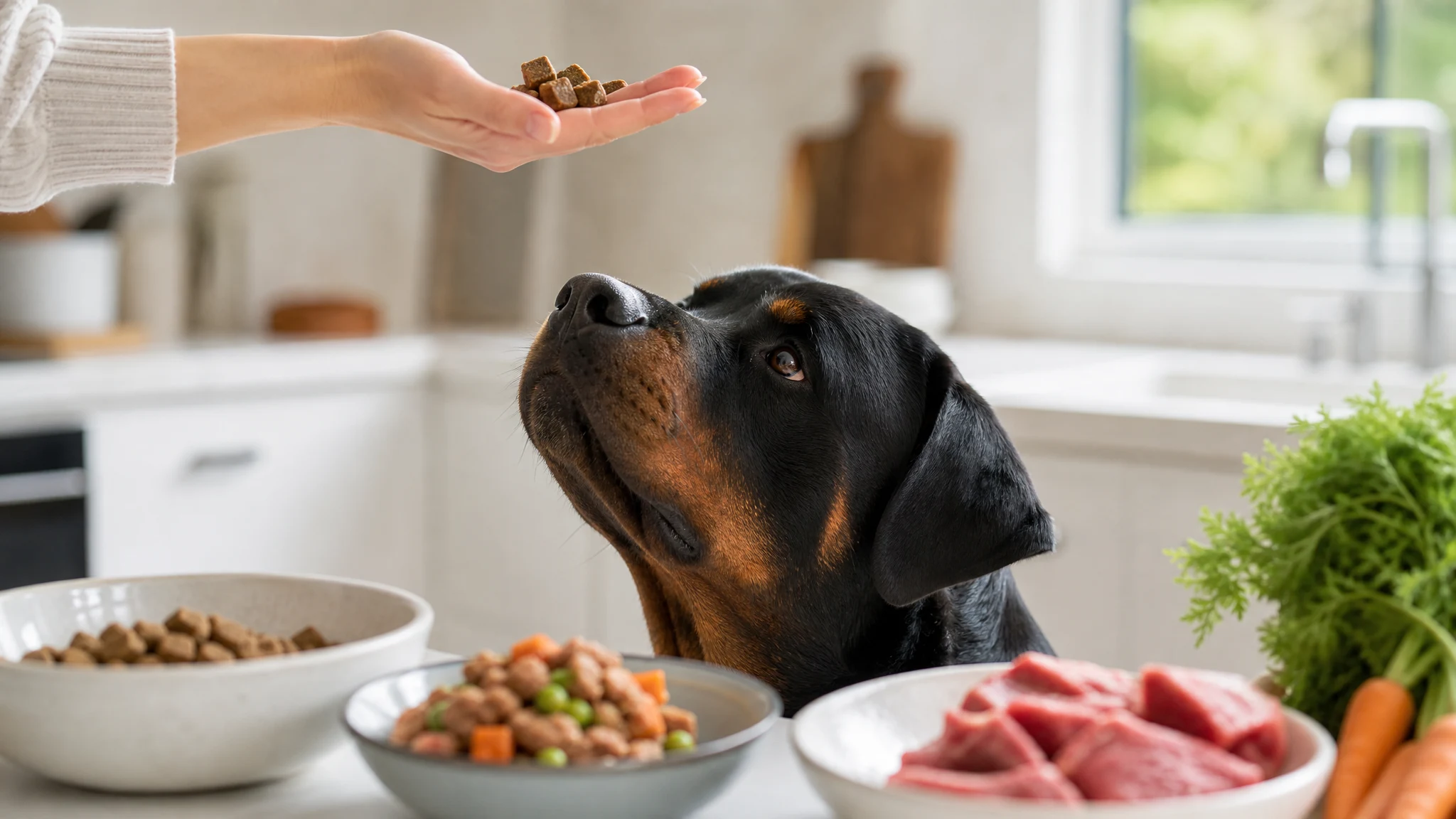
General nutrition information compiled from product labels and published sources, not veterinary advice. Your veterinarian is the right person to choose a diet for your dog, especially one with a health condition.
Rottweilers are food-motivated, strong and fast learners, which makes treats a useful training tool. They are also a large breed that can gain weight, so treats need a plan.
This guide shows how to pick the best treats for Rottweilers, cut them to the right size, and count them against a day's food. It does not rank brands. Treats vary a lot, and the label on the bag in your hand matters more than any list.
Why treat planning matters for this breed
Hill's Pet Nutrition, in its Rottweiler breed page, puts adult weight at 80 to 135 pounds and life expectancy at 9 to 10 years. The same page notes that reduced activity with age may lead to extra weight, and that a lean body condition supports joint health in a breed where hip and elbow problems are common.
Treats are easy to forget when you count calories. A dog that gets a dozen treats in a training session plus a full meal can be eating more than you think. That is the main reason to plan.
Nothing here treats or prevents any condition. A veterinarian decides what is right for an individual dog, especially a dog with joint concerns, allergies or a weight problem.
What you need
- Your dog's regular food, with the calories per cup from the bag. The label-data comparison of Rottweiler foods shows where to find that number.
- A kitchen scale. Hill's recommends weighing daily portions for this breed.
- Two or three kinds of treats from the categories below.
- A small treat pouch or bowl, and a cutting board and knife for slicing.
- The calories-per-treat figure from each treat package. If it is missing, check with the brand.
- A notebook or phone note to log what your dog ate.
The three treat categories worth knowing
Soft training treats
These are moist, chewy and easy to break into tiny pieces. They are quick to swallow, so your dog stays focused on you instead of crunching. Many are made for training and are sold in small pieces already.
Read the label for the AAFCO statement, the ingredient list and the calories per treat. Soft treats can be calorie-dense, so the size you cut matters.
Freeze-dried single-protein treats
These contain one animal ingredient, such as a single meat. The short ingredient list is useful if you are tracking what your dog eats, and the strong smell works well for high-value rewards.
They are light and crumble easily, so they are simple to break into small pieces. Check the package for calories per piece. Do not assume a freeze-dried piece is low in calories just because it is light.
Vegetables
Small pieces of plain vegetable can serve as low-calorie rewards for dogs that like them. Some dogs ignore vegetables, so test one at a time. Ask your veterinarian which vegetables are safe, because some common foods, such as onions and grapes, are unsafe for dogs.
Vegetables are not a stand-in for every reward. For harder tasks, such as coming when called outdoors, most dogs need something more exciting.
Step-by-step: choosing and using treats
Step 1: Find your dog's daily calories
Start with the feeding guide on your dog's food. These are label starting points, not prescriptions. For example, the Royal Canin Rottweiler Adult page lists 366 kcal per cup and gives an 88 pound dog at low activity 4 cups a day. Hill's Science Diet Adult Large Breed lists 390 kcal per cup and 5 cups a day for a 100 pound dog.
Multiply cups by calories per cup to get a rough daily total. Your dog's own needs may differ, and your veterinarian can adjust the number.
Step 2: Apply the 10 percent rule
WSAVA, the World Small Animal Veterinary Association, is among the groups whose nutrition guidance is commonly summarized as keeping treats to about 10 percent of daily calories. Meals provide the rest.
Using the Royal Canin label example, 4 cups at 366 kcal is about 1,464 kcal. Ten percent is roughly 146 kcal for treats. That is arithmetic from label data, not a feeding recommendation for your dog. If your dog is overweight, ask your veterinarian whether the treat share should be lower.
Step 3: Turn the calorie budget into a treat count
Divide the treat budget by the calories in one treat piece. If a package says a treat is 3 kcal, a 150 kcal budget is about 50 pieces. If a package says 30 kcal per treat, it is about 5 pieces.
This is why "how many" has no single answer. It depends on your dog's food, the treat and the piece size.
Step 4: Cut treats small
For a large dog, a good training piece is roughly pea-sized or smaller. A Rottweiler does not need a big piece to know it did well. A small piece is eaten fast and lets you repeat the exercise many times.
Break soft treats in halves or quarters. Crumble freeze-dried pieces. Slice vegetables thin. Smaller pieces also keep the calorie count honest.
Step 5: Measure the day's treats in the morning
Put the day's treats in a small container before training starts. When the container is empty, treats are done. This is the simplest way to stay within budget when several people in a household feed the dog.
Step 6: Reward the right moment, every time
Reward-based training fits AVSAB's position on humane methods. Deliver the treat within a second or two of the behavior you want. A marker word such as "yes" right when your dog sits helps bridge the gap.
Start with high-value treats while learning something new. Move to lower-value treats once the behavior is reliable, and mix in praise and play.
Step 7: Take treats out of the meal when training is heavy
On days with long sessions, take a little out of the regular meal. Weigh the meal on the kitchen scale and reduce it by roughly the calories in the treats you used. Small adjustments, checked against your dog's body condition, are easier than big ones.
Step 8: Check body condition every few weeks
You should be able to feel your dog's ribs under a thin layer of fat. If you cannot, treats or meals may be too generous. Your veterinarian can show you how to score body condition.
Special notes for puppies
Hill's says Rottweiler puppies benefit from a large-breed puppy formula with controlled bone and joint growth, and lists adulthood at 12 to 18 months. Treats can undermine that careful feeding if they pile up.
Count treats against the puppy's daily calories the same way. Use tiny pieces, and prefer treats made for puppies, or ask your veterinarian before using adult treats. Do not add calcium or other supplements to "balance" treats. Ask your veterinarian first.
Common mistakes to avoid
- Treating without counting. Calories from treats add up quickly in a dog this size.
- Cutting pieces too big. A large piece takes longer to eat and breaks the training rhythm.
- Using the same treat for everything. Dogs lose interest. Rotate between categories.
- Trusting front-of-package claims. Words like "natural" or "premium" are marketing. Read the ingredient list and the calorie statement.
- Handing out treats for free. Treats given for nothing teach nothing. Tie them to behavior.
- Using treats to fix fear or aggression. If your Rottweiler growls, lunges or seems afraid, ask your veterinarian for a referral to a qualified behavior professional.
- Changing treats suddenly. New foods can upset a dog's stomach. Introduce one new treat at a time.
- Using harsh tools. Shock, prong or choke collars and dominance methods are not part of reward-based training and are not recommended.
How we approach treat advice
We compared label information, such as calories and ingredient lists, and published guidance. We did not run feeding trials or taste tests, and we do not rank individual treat brands. The right treat is one your dog tolerates, that fits the calorie budget and that you can portion easily.
What to expect
Used consistently, small rewarded repetitions may help your Rottweiler learn cues faster and stay motivated. Results vary by dog, age and how often you practice. Keeping treats within a calorie budget may also make it easier to maintain a lean body condition, though no treat plan can promise a particular weight or health outcome.
If your dog gains weight, itches, has loose stools or loses interest in meals after you add a treat, stop that treat and call your veterinarian.
Quick reference
| Treat type | Good for | Watch for |
|---|---|---|
| Soft training treats | Fast, repeated rewards | Calorie density; cut small |
| Freeze-dried single protein | High-value rewards, short ingredient lists | Calories per piece; crumbling |
| Vegetables | Low-calorie rewards for dogs that like them | Dogs that refuse them; unsafe foods |
Putting it together
Pick one or two treats from the categories above, read the calorie figure, set the budget at about 10 percent of daily calories, and cut the pieces small. Check your dog's body condition regularly and adjust meals as needed.
For food choices that anchor the rest of the day, see the Rottweiler food comparison by label data. Your veterinarian can set a calorie target and a treat plan for your individual dog.