Wet vs Dry vs Fresh Food for Rottweilers
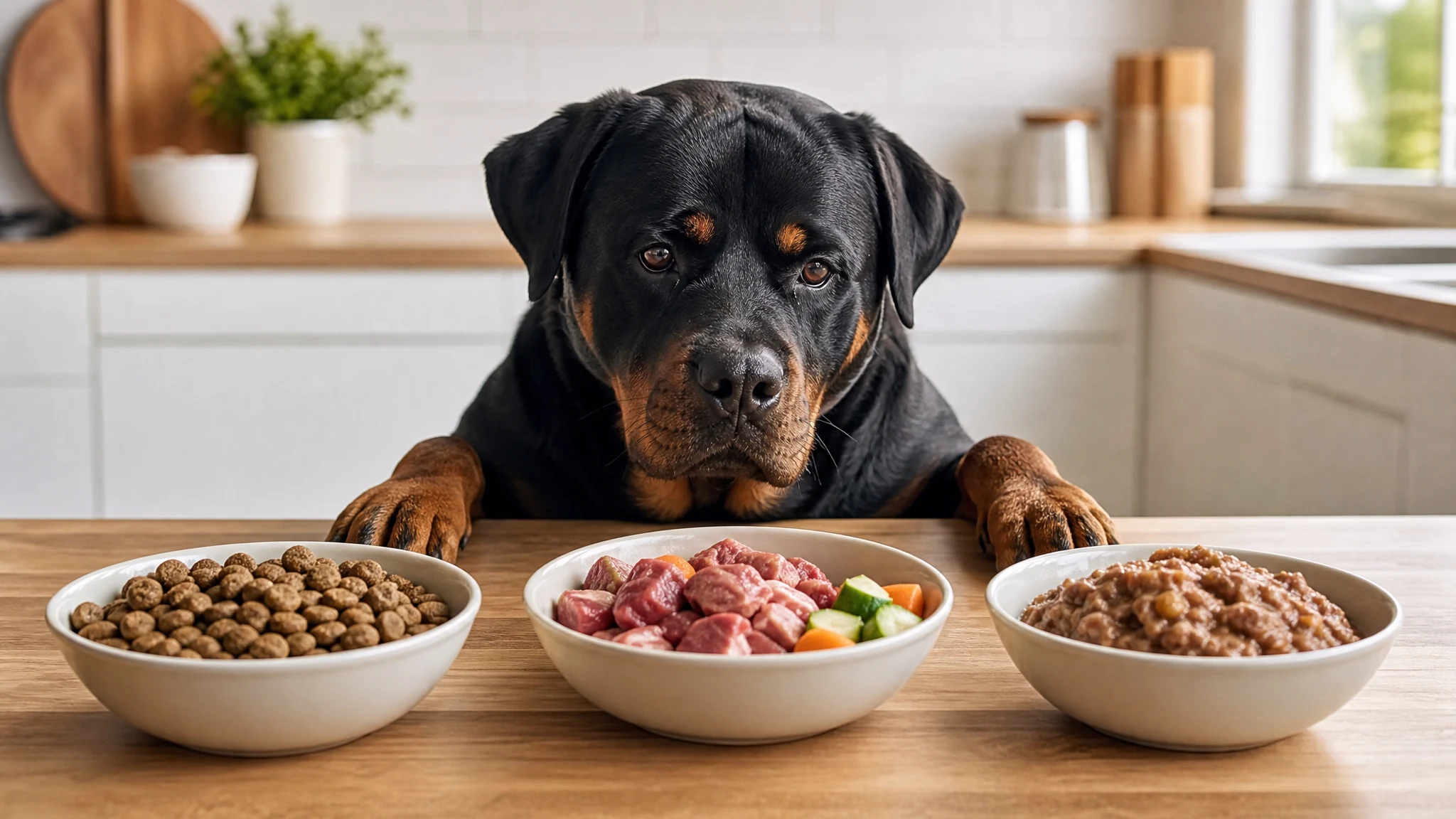
General nutrition information compiled from product labels and published sources, not veterinary advice. Your veterinarian is the right person to choose a diet for your dog, especially one with a health condition.
Most Rottweiler owners end up weighing the same three choices: kibble, canned food, or refrigerated fresh food. Each has real strengths. Each also has marketing built around it.
This page compares wet vs dry dog food and fresh dog food for Rottweilers using label data only. We compared published ingredient lists, calorie figures, nutrient statements and feeding guides. We did not run feeding trials or taste tests, and we have not fed any of these foods to dogs. Nothing here tells you which food your dog should eat. A veterinarian decides that for an individual dog.
Why the form of food matters for a Rottweiler
Hill's Pet Nutrition lists adult Rottweilers at roughly 80 to 135 pounds, with males usually heavier than females. That puts the breed firmly in the large category. A big dog eats a lot of food by volume, and that shapes the wet, dry and fresh decision more than anything else.
Hill's also notes that reduced activity with age may lead to extra weight, and that lean body condition supports joint health in a breed prone to hip and elbow dysplasia. Its advice is to measure daily portions with a kitchen scale. That advice applies to every form below. A food only helps a dog if the amount is right.
Hill's gives a typical life expectancy of 9 to 10 years and says Rottweilers are adult at 12 to 18 months. So the right food changes at least three times: growth, adult, and later life.
The three forms at a glance
| Attribute | Dry (kibble) | Wet (canned) | Fresh (refrigerated or frozen) |
|---|---|---|---|
| Moisture | Lowest of the three. Nutrients are concentrated. | High. The Hill's Science Diet wet recipe lists water as its first ingredient. | High. Freshpet, JustFoodForDogs and Nom Nom lists lead with meat, broth or vegetables. |
| Calories (label examples) | 352 to 390 kcal per cup across the dry foods compared here | 368 kcal per 13 oz can (Hill's Science Diet Adult Chicken & Barley Entree) | 201 kcal per cup (Nom Nom Beef Mash); 304 to 309 kcal per half pound (Freshpet rolls) |
| Large-breed or Rottweiler options | Several, including two Royal Canin Rottweiler formulas and Hill's and VICTOR large-breed formulas | Hill's wet recipe is for all adult sizes, with a feeding chart to 120 lb | Mostly not breed-specific; some cover growth for large dogs |
| Cost per day for a large dog | Usually the lowest of the three | Usually higher, because a big dog needs many cans | Usually the highest |
| Storage | Pantry | Pantry until opened, then refrigerate | Refrigerator or freezer space needed |
| Kibble size | Not stated on the product pages we compared | Not applicable | Freshpet suggests cutting rolls into 1-inch cubes or smaller |
The cost row is a general pattern, not a price. Current prices change, so check each brand's own page.
Moisture: the comparison trap
Moisture is the biggest source of confusion when comparing labels. A guaranteed analysis is written on an as-fed basis, so a food that is mostly water will always look low in protein and fat.
The fresh foods show this clearly. Freshpet Vital Chicken Recipe lists a 9.5% protein minimum and 7% fat minimum. The Royal Canin Rottweiler Adult dry food lists 24% protein minimum and 18% fat minimum. Those numbers cannot be compared directly. The fresh food is not weaker. It simply carries far more water.
Hill's helps here. Its pages give average nutrient content on a dry matter basis, which removes water from the math. The adult large breed dry recipe averages 23.8% protein and 16.3% fat. The Adult Chicken & Barley wet entree averages 26.7% protein and 16.7% fat. Hill's states these are averages, not guaranteed minimums. Even so, on a level basis the two are in the same range.
The practical lesson: compare dry matter figures, or compare calories, not the raw percentages across forms.
Calories and portions for a large dog
Calories per cup look similar across the dry foods. Royal Canin Rottweiler Adult lists 366 kcal per cup, VICTOR Classic Elite Canine lists 386, and Hill's Science Diet Adult Large Breed lists 390. Wet and fresh foods are harder to line up, because the brands use cans, rolls, pounds and cups.
Here are a few label starting points:
- Hill's Science Diet Adult Large Breed dry suggests 5 cups a day for a 100 lb dog. At 390 kcal per cup, that is about 1,950 kcal, by simple arithmetic from the label.
- The Hill's Science Diet wet entree suggests up to 6 cans a day for a 120 lb dog. At 368 kcal per can, that is about 2,208 kcal.
- Freshpet lists 2 lb a day, plus 1/4 lb for each additional 25 lb, for dogs over 100 lb.
- JustFoodForDogs points owners to a feeding calculator on its page rather than a fixed amount.
These are label guides, and the brands say to adjust to keep the dog at an optimal weight. Treat them as starting points. Weigh the portion, watch the dog's body condition, and ask a veterinarian if you are unsure.
One practical note: six cans a day is a lot of cans. For a heavy male Rottweiler, feeding only canned food means a lot of opening, storing and spending.
Dry food: pros and cons
Pros
- The widest choice for the breed. Royal Canin makes both a Rottweiler Adult and a Rottweiler Puppy formula, and Hill's and VICTOR offer large-breed recipes.
- Easy to measure by weight on a kitchen scale, which supports the lean-weight goal Hill's describes.
- Simple storage, and usually the lowest cost per day in general terms.
- Many large-breed puppy options, which matters because Hill's says Rottweiler puppies benefit from a large-breed puppy formula.
Cons
- Low moisture, so it does nothing for a dog that drinks little.
- Calorie density makes overfeeding easy if portions are scooped by eye.
- Kibble size is not listed on the product pages we compared, so check with the brand if your dog gulps or struggles with large pieces.
Wet food: pros and cons
Pros
- High water content, and many dogs find it very appealing.
- Useful as a topper for a dog that is going off its kibble.
- Shelf stable until opened.
Cons
- Wet food for Rottweilers is expensive to feed as the whole diet, because of the volume a 100 lb dog needs.
- The Hill's wet recipe we compared is for adults 1 to 6 years old and is not for puppies, pregnant or nursing dogs. It is also not a breed-specific food.
- Opened cans must be refrigerated, and large dogs go through them fast.
Fresh food: pros and cons
Pros
- Recognizable whole ingredients. Freshpet Vital leads with chicken, chicken liver, peas and carrots. JustFoodForDogs Beef & Russet Potato leads with beef, beef liver and potatoes.
- Some recipes cover growth. Freshpet Vital and Nom Nom Beef Mash both state AAFCO nutrient levels for all life stages, including growth of large dogs that reach 70 lb or more as adults.
- Easy to portion by weight, since feeding guides are written in pounds.
Cons
- Usually the highest daily cost for a dog this size.
- Needs refrigerator or freezer space. Large dogs need a lot of it.
- Not every recipe suits every life stage. JustFoodForDogs says its Beef & Russet Potato recipe is not intended for growing puppies, and the Freshpet Chunky Chicken & Turkey roll is listed for adult maintenance.
- Calorie numbers are not always given per cup. Freshpet lists calories per half pound, and JustFoodForDogs lists them per ounce, per kilogram and per package.
- Grain-free is not the same as better. JustFoodForDogs lists its recipe as grain-free. Nom Nom's grain-free status is not stated on the page we checked, so ask the brand.
If you are searching for fresh dog food for Rottweilers, the label review matters more than the packaging. Look for an AAFCO statement that matches the dog's life stage first.
Dental myths
A common belief is that dry food cleans teeth and wet or fresh food ruins them. The label data we compared says nothing that supports either claim. None of the product pages we reviewed present dental results for the specific food, and we did not test any food ourselves.
Dental health depends on the individual dog, chewing habits, and care such as brushing. If you are worried about your Rottweiler's teeth, a veterinarian can check the mouth and advise on the right approach. Do not pick a food form only because of a dental claim.
Mixing forms
Many owners combine forms, such as kibble with a spoonful of wet food on top, or kibble plus a fresh roll. It can work well for appetite and budget. Three cautions apply.
- Count both foods in the calories. Toppers add calories. If you add a quarter of the wet food, reduce the kibble so the total stays near the target.
- Check life stage on both. A puppy should not get an adult-only wet or fresh food as a large part of the diet. The Hill's wet entree and the JustFoodForDogs recipe above both say not for puppies.
- Change slowly. A sudden swap can upset a dog's stomach. Mix the new food in gradually, and ask your veterinarian if the dog has digestive trouble.
Best for: use-case recommendations
| Situation | Form that often fits | Why |
|---|---|---|
| Rottweiler puppy, 8 weeks to 18 months | Dry large-breed puppy formula | Royal Canin Rottweiler Puppy, Hill's Science Diet Puppy Large Breed and VICTOR Hi-Pro Plus Large Breed Puppy are all labeled for growth. Hill's recommends a large-breed puppy formula for the breed. |
| Healthy adult on a normal budget | Dry | Most options, simplest portioning, usually the lowest daily cost. |
| Dog with a weak appetite | Dry with a wet topper | Adds aroma and moisture. Count the added calories. |
| Owner who wants whole-food ingredients | Fresh, or fresh mixed with dry | Recognizable ingredients, but check life stage and budget for a 100 lb dog. |
| Dog gaining weight | Whichever form you can weigh accurately | The form matters less than the measured portion. Ask a veterinarian for a target. |
| Older Rottweiler | Dry senior large-breed, or a form your veterinarian recommends | Hill's Science Diet Adult 6+ Large Breed lists 352 kcal per cup, lower than the adult large-breed recipe. |
The verdict
For most Rottweilers, a complete and balanced dry food in the right life stage is the practical default. It offers the most breed-appropriate options, is the easiest to measure by weight, and usually costs the least per day for a dog this size.
Wet food is best used as a topper or a short-term appetite helper, not usually as the entire diet. Its price and volume add up quickly for a dog that can weigh 80 to 135 pounds.
Fresh food is a reasonable choice for owners who value ingredient lists they recognize and can afford the cost and fridge space. Read the life stage on every recipe. Two of the fresh foods compared here are not for puppies, while Freshpet Vital and Nom Nom Beef Mash state large-dog growth coverage.
The reasoning is simple. The AAFCO statement, the dog's life stage, the calories and the measured portion matter more than the form. A well-matched dry food fed carefully beats a poorly matched fresh food fed by eye. No form prevents or treats hip dysplasia or any other condition. Hill's says only that lean body condition supports joint health, and your veterinarian decides what is right for your dog.
For a side-by-side look at individual products, see our label-data comparison of Rottweiler foods. Before switching, check the current label and feeding guide on the brand's own page.
Sources
- Hill's Pet Nutrition, Rottweiler breed page
- Royal Canin, Rottweiler Adult
- Royal Canin, Rottweiler Puppy
- Hill's Science Diet, Adult Large Breed
- Hill's Science Diet, Puppy Large Breed
- Hill's Science Diet, Adult 6+ Large Breed
- Hill's Science Diet, Adult Chicken & Barley Entree (wet)
- VICTOR, Classic Hi-Pro Plus Large Breed Puppy
- VICTOR, Classic Elite Canine
- Freshpet, Vital Chicken Recipe
- Freshpet, Chunky Chicken & Turkey Roll
- JustFoodForDogs, Beef & Russet Potato
- Nom Nom, Beef Mash