Best Puppy Food for Rottweiler Puppies
General nutrition information compiled from product labels and published sources, not veterinary advice. Your veterinarian is the right person to choose a diet for your dog, especially one with a health condition.
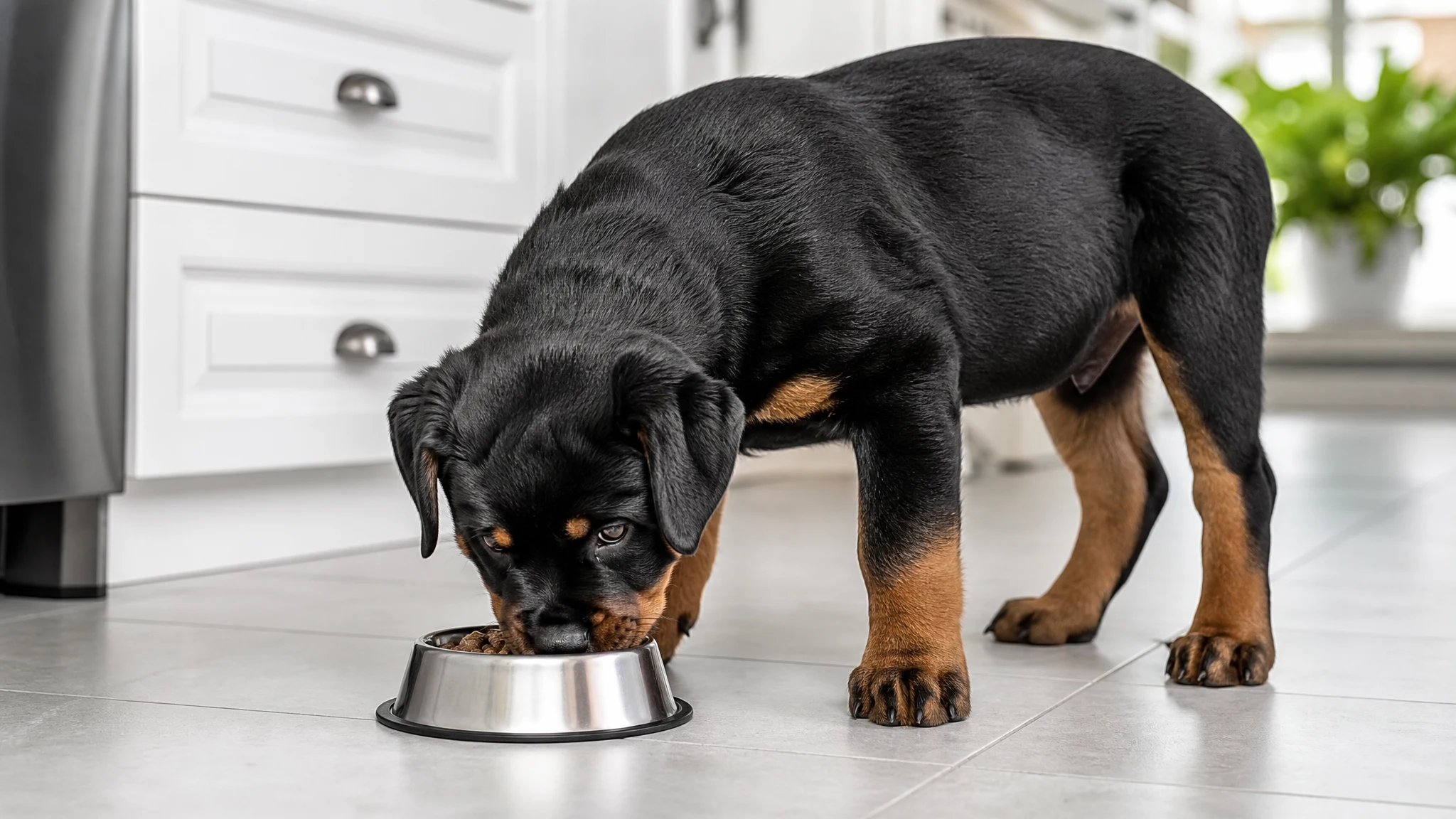
Choosing the best puppy food for Rottweilers is mostly a matter of reading labels carefully. Pet food marketing is loud, and a puppy that may reach 80 to 135 pounds as an adult (a range given by Hill's Pet Nutrition on its Rottweiler breed page) needs a food built for growth, not just a bag with a big dog on the front.
This guide explains what to look for, how to compare labels, and how five growth-ready foods line up on paper. It is a label comparison. We did not run feeding trials or taste tests, and we are not claiming any food works better than another for your puppy.
Why Rottweiler puppies need a growth-specific food
Rottweilers are a large breed. Hill's says Rottweiler puppies benefit from a large-breed puppy formula, described as controlled bone and joint growth. That is the main reason a generic all-purpose food is not the default choice here.
Hill's also lists hip and elbow dysplasia among the joint development problems seen commonly in the breed, and notes that a lean body condition supports joint health. No food prevents or treats these conditions. What a food and a feeding routine can do is help you keep a growing puppy lean. Your veterinarian decides what is right for your individual dog.
The same page says Rottweilers are considered adult at roughly 12 to 18 months of age. That window matters, because the food you pick now is a food for about a year and a half, not for life.
What to look for on the label
1. A growth statement from AAFCO
Start with the small print. The label should say the food is formulated to meet the AAFCO Dog Food Nutrient Profiles for growth, or for all life stages, or that feeding tests substantiate it for growth. A food that says it is for adult maintenance only is not a puppy food, even if the bag shows a puppy.
2. Large-size wording
For a Rottweiler, look for wording that the growth claim covers large dogs, such as "including growth of large-size dogs (70 lb or more as adults)." Some product pages we reviewed use that wording and some only say "large breed puppy." If the page or bag does not spell out the large-size growth wording, check with the brand.
3. Named ingredients in the first five
Ingredients are listed by weight before cooking, so fresh meat that is mostly water can sit high on the list and shrink after processing. A named meal such as chicken meal is a concentrated protein. Neither is automatically better. What you want is to be able to tell what each ingredient is.
4. Guaranteed analysis, read carefully
The guaranteed analysis lists minimum protein and fat and maximum fiber (and moisture). Some brands publish "average nutrient content on a dry matter basis" instead, which is a different measure and not a guaranteed minimum. Do not compare the two directly. Wet and fresh foods are mostly water, so their percentages look low next to kibble even when they are complete.
5. Calories per cup
Calorie density tells you how fast a bowl turns into weight. Two foods can look similar and differ enough per cup to change a puppy's growth curve over months. Compare kcal per cup, and for fresh foods, kcal per pound or kilogram.
6. Kibble size
None of the product pages we looked at gave a clear kibble size in numbers. If a puppy has trouble chewing or gulps food, ask the brand or your veterinarian about it.
Key features to compare
- Growth and large-size wording: does the statement cover growth, and large dogs specifically?
- Calories per cup: a measure of how much you will feed.
- Protein, fat and fiber: on the same basis (minimums with minimums).
- Format: dry, fresh or mixed.
- Feeding guide: a starting point, not a target.
- Transition plan: when the brand says to switch to adult food.
Five growth-ready foods compared by label
We limited this list to foods whose label wording covers growth. Adult-only and maintenance-only foods are left out on purpose, however popular they are.
| Food | Format | Growth wording | Protein | Fat | Fiber | Energy |
|---|---|---|---|---|---|---|
| Royal Canin Breed Health Nutrition Rottweiler Puppy | Dry | Growth profile | 29% min | 14% min | 3.6% max | 358 kcal ME per cup |
| Hill's Science Diet Puppy Large Breed Chicken & Brown Rice | Dry | Feeding tests, growing puppies | 26.7% avg (dry matter) | 15.4% avg (dry matter) | 2.8% avg (dry matter) | 387 kcal per cup |
| VICTOR Classic Hi-Pro Plus Large Breed Puppy | Dry | All life stages | 30% min | 14% min | 6.0% max | 365 kcal per cup |
| Freshpet Vital Chicken Recipe with Peas, Carrots & Brown Rice | Fresh roll | All life stages, including large dogs | 9.5% min | 7% min | 1.5% max | 1,363 kcal/kg |
| Nom Nom Beef Mash | Fresh | All life stages, including large dogs | 8% min | 5% min | 4% max | 201 kcal per cup |
Remember the caveats. The Hill's numbers are dry matter averages, not guaranteed minimums. The fresh foods contain much more water, so their percentages are not comparable to kibble.
Top picks by type of buyer
We do not list prices. Prices change by store, bag size and region, and we would rather not guess. Check the current cost with each brand. Instead, these picks are grouped by what a buyer is most likely to want.
For a breed-specific formula: Royal Canin Rottweiler Puppy
According to the Royal Canin product page, this dry food is a Rottweiler formula for puppies from 8 weeks to 18 months, formulated to the AAFCO profile for growth. The page also covers large dogs of 70 pounds or more as adults, but the full statement is longer than the excerpt we saw, so read the bag.
The first five ingredients are chicken by-product meal, brewers rice, wheat gluten, brown rice and chicken fat. It contains grain. Some owners dislike by-product meal on principle, while others see it as a normal concentrated protein. That is a judgment for you and your veterinarian, not a safety verdict from us.
Royal Canin's feeding example: at 2 months, for a target adult weight of 88 pounds, 3 cups (293 grams) per day. The page says to switch to its Rottweiler Adult food after 18 months.
For a large-breed puppy formula from a long-established nutrition brand: Hill's Science Diet Puppy Large Breed
The Hill's product page describes this food for large-breed puppies (over 55 pounds as adults) up to 18 months, substantiated by AAFCO feeding tests for growth. The first five ingredients are chicken, brown rice, whole grain oats, chicken meal and cracked pearled barley.
It carries 387 kcal per cup, the highest among the dry foods here. That does not make it better or worse. It means a cup goes further, so portions may be smaller. The page tells owners to adjust amounts to maintain optimal weight and to ask a veterinarian if unsure. Since the page text we saw was partial, check the bag for the full statement and any large-size wording.
For a higher-protein, grain-inclusive dry option: VICTOR Classic Hi-Pro Plus Large Breed Puppy
The VICTOR product page lists this dry food as meeting the AAFCO profile for all life stages, with mention of large-size growth. Its guaranteed minimums are 30% protein and 14% fat, with fiber at 6.0% maximum, the highest fiber of the dry options here. It provides 365 kcal per cup.
The first five ingredients are chicken, chicken meal, brown rice, whole grain millet and whole grain sorghum. The page says it uses an appropriate kibble size for large breeds but does not give a measurement. Its example feeding amount is 1 3/4 cups a day for a 3 to 4 month old puppy weighing 10 pounds. A Rottweiler will often be heavier at that age, so use the chart for your puppy's weight on the brand page, not this example.
For fresh food buyers: Freshpet Vital and Nom Nom
Two fresh options carry wording that includes growth of large dogs.
- The Freshpet Vital Chicken Recipe is formulated for all life stages, including growth for large dogs (70+ pounds as adults). It is a refrigerated roll, with chicken, chicken liver, peas, carrots and chicken broth as the first five ingredients. Freshpet gives 1,363 kcal per kilogram, calculated, and 309 kcal per half pound. It gives no per-cup figure, so the brand's guide is the place to work out portions.
- The Nom Nom Beef Mash is formulated for all life stages, including growth of large-size dogs (70 pounds or more as adults). Its first five ingredients are ground beef, russet potatoes, eggs, carrots and peas. It is 201 kcal per cup, calculated. Nom Nom points owners to its Daily Feeding Guide for full meals, and we could not confirm whether it is grain free, so ask the brand if that matters to you.
Fresh foods are lower in calories per cup, which means a large puppy eats a lot of volume. Check storage needs and the real daily cost with the brand before committing.
Red flags to avoid
- No growth statement. If the label says adult maintenance only, it is not for a Rottweiler puppy. For example, the JustFoodForDogs Beef & Russet Potato recipe says it is not intended for growing puppies.
- Vague "all breed" claims with no mention of large dogs. Ask the brand if the growth claim applies to dogs that will be 70 pounds or more.
- Health claims. A bag or website that says a food prevents, treats or cures hip dysplasia, allergies or heart disease is overstepping. Only a veterinarian prescribes diets for medical conditions.
- Missing or partial information. If a brand will not tell you calories per cup or the full AAFCO statement, that is worth noting.
- Comparing across bases. A dry matter average next to a guaranteed minimum can mislead you.
- Constant switching. Changing foods every few weeks makes it hard to tell what is working.
- Treating the feeding chart as a rule. Charts are starting points.
How to feed a Rottweiler puppy
Weigh portions with a kitchen scale rather than a scoop. Hill's recommends measuring daily portions this way, because scoops vary a lot and a big, fast-growing puppy can gain extra weight quickly.
Split the daily total into several meals rather than one large one. Most puppies do well on three or four small meals when young, and the number often drops as they grow. Your veterinarian can tell you the right schedule for your puppy. Do not guess, and do not free-feed.
Use the label's feeding guide as a starting point. Then watch your puppy's body shape and check in with your veterinarian at visits. A lean puppy where you can feel the ribs under a light covering is the goal. Hill's notes that lean condition supports joint health. If your puppy is gaining too fast or looking thin, the veterinarian can help adjust the amount.
When to switch to adult food
Hill's says Rottweilers reach adulthood at about 12 to 18 months. Royal Canin's puppy page says to move to its Rottweiler Adult formula after 18 months, and Hill's large-breed puppy food runs up to 18 months. Your veterinarian can help you pick the timing based on your dog's size and body condition.
When you change, do it gradually over about a week by mixing increasing amounts of the new food with the old one. Adjust the amount, because calories per cup differ. For example, Royal Canin Rottweiler Adult lists 366 kcal per cup against 358 for the puppy formula, which is close, but not every pair of foods is.
Where to buy
We do not recommend or link to any store. Start at the brand's own site and use its product page to confirm the exact formula name, the full AAFCO statement and the bag size. Many brands show where their foods are sold or sell direct. Fresh and frozen foods often come straight from the maker or through a subscription, so ask about delivery, storage and what a pause or cancellation involves.
Whichever way you buy, check the date on the bag, store dry food sealed and cool, and keep the original bag so you have the lot number and label handy. Ask your veterinarian's office too, since they may stock or recommend options.
The bottom line
There is no single best food for a Rottweiler puppy. The best food for a Rottweiler puppy is one with a clear growth statement that covers large dogs, a calorie level you can portion accurately, ingredients you understand and a brand that answers questions. Any of the five foods above can fit that description on paper, but only a veterinarian watching your puppy's growth can tell you whether it is working.
Pick one, measure it, split it into several meals and keep your puppy lean. Then review the plan with your veterinarian as your puppy heads toward adulthood at 12 to 18 months.
Sources
- Hill's Pet Nutrition, Rottweiler breed page
- Royal Canin, Rottweiler Puppy product page
- Royal Canin, Rottweiler Adult product page
- Hill's Science Diet Puppy Large Breed product page
- VICTOR Classic Hi-Pro Plus Large Breed Puppy product page
- Freshpet Vital Chicken Recipe product page
- Nom Nom Beef Mash product page
- JustFoodForDogs Beef & Russet Potato product page