Best Food for Senior Rottweilers
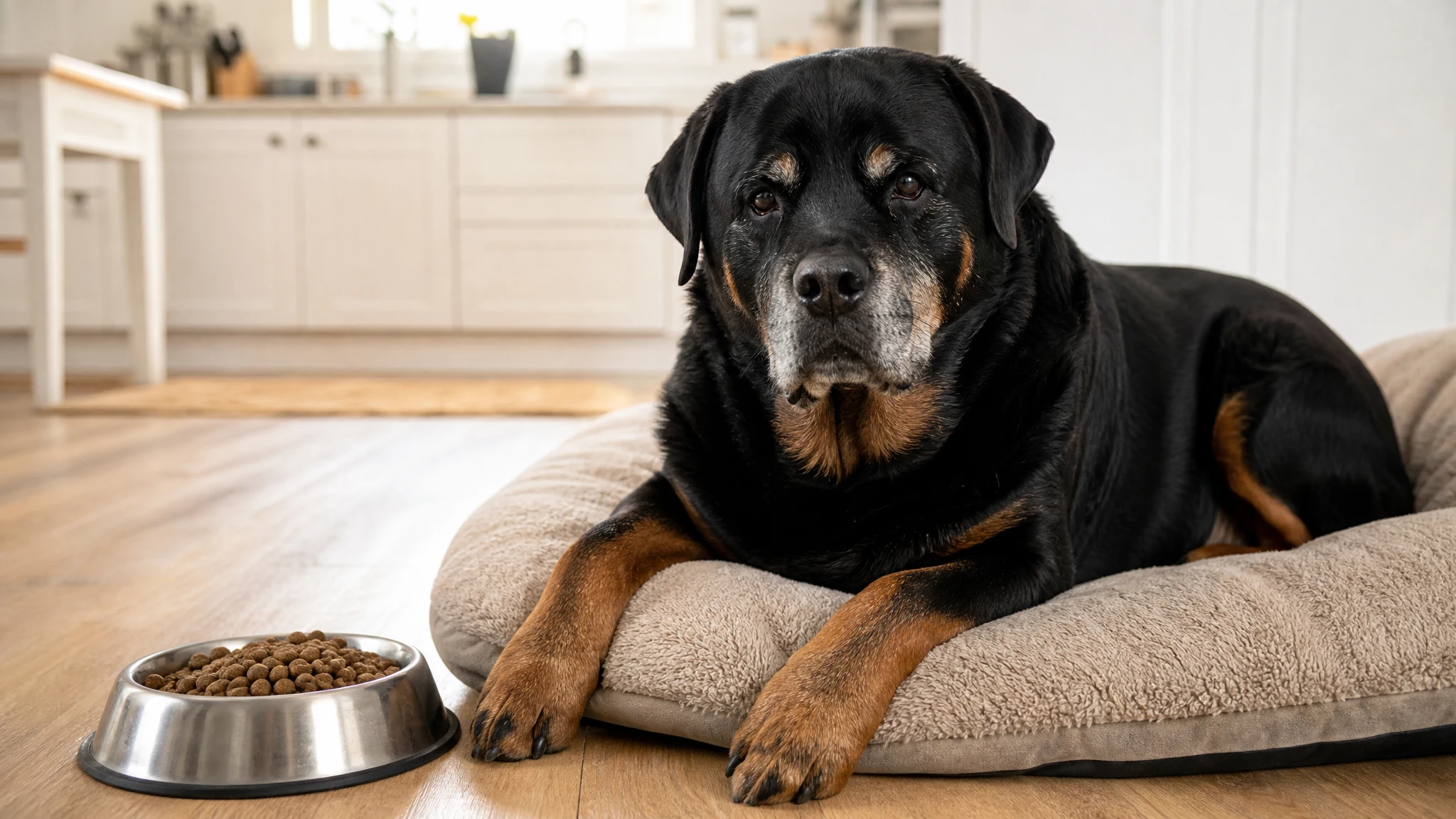
General nutrition information compiled from product labels and published sources, not veterinary advice. Your veterinarian is the right person to choose a diet for your dog, especially one with a health condition.
Finding the best senior dog food for Rottweilers is mostly a matter of reading labels well. Marketing for older dogs is loud. The useful details are quieter: the nutritional adequacy statement, the calories per cup, the ingredient order and the feeding guide.
This guide covers senior Rottweiler food from a label-reading angle. It sticks to product quality and does not make medical claims. Your veterinarian decides what is right for an individual dog.
One note on method. We compared label data published by each brand. We did not run feeding trials or taste tests, so nothing here says how a dog will do on a food.
Why older Rottweilers need a closer look at the label
Hill's Pet Nutrition's Rottweiler breed page lists an adult weight of 80 to 135 pounds and a life expectancy of 9 to 10 years. It says Rottweilers are adults at 12 to 18 months. With a lifespan like that, many owners start thinking about "senior" food in the middle years.
The same page makes two points that matter for food. Hip and elbow dysplasia are common joint problems in the breed, and a lean body condition supports joint health. It also says reduced activity with age may lead to extra weight, and it suggests measuring daily portions with a kitchen scale.
In practice, then, calorie control and body condition matter more than any "senior" wording on the bag.
Is there such a thing as a senior formula?
Not in the way the front of a bag suggests. Among the products we compared, the labels carry either an adult maintenance statement or an all life stages statement. The Hill's Science Diet Adult 6+ Large Breed formula, which is aimed at large dogs 6 and older, carries a statement for "maintenance of adult dogs." It does not use a separate senior statement.
So "senior" is largely a marketing and formulation choice by the brand. For the current rules on how AAFCO treats older dogs, check with AAFCO directly or ask the brand.
What you can do is look for a complete and balanced statement that fits an adult dog, then compare calories and ingredients yourself.
What to look for: quality indicators
A clear adequacy statement
The label should say the food is formulated to meet AAFCO nutrient profiles, or that feeding tests substantiate it. For an older Rottweiler, look for "adult maintenance" or "all life stages." A puppy-only statement is the wrong fit.
Calories you can actually find
A trustworthy label gives calories per cup or per kilogram. You need this number to portion food by weight and to adjust if your dog gains or loses.
Named ingredients near the top
Ingredient lists run by weight before cooking, so read the first five with some skepticism. Named sources such as chicken, chicken meal or beef are easy to understand. Vague terms are harder to judge.
A feeding guide that covers a big dog
Some feeding charts stop well below Rottweiler size. Check that the guide covers your dog's weight. Treat it as a starting point and adjust to body condition.
Key features to compare
Compare these across any short list:
- Adequacy statement: adult maintenance or all life stages.
- Calories per cup: a higher number means a smaller portion for the same energy.
- Protein, fat and fiber: guaranteed minimums and maximums are not the same as the "average" dry matter figures some brands publish.
- Form: dry, wet or fresh. Moisture differs, so percentages on a fresh food label cannot be compared directly with a dry food label.
- Size fit: a large-breed or Rottweiler-specific formula versus a general one.
- Kibble size and shape: none of the brands in this comparison listed kibble size in the data we reviewed, so ask the brand if texture matters for your dog.
Joint and dental comfort come up often with older dogs. The Hill's breed page ties lean body condition to joint health, which is one more reason to watch calories. We found no label data on dental benefits for these foods, so do not assume any. Raise chewing trouble or sore teeth with your veterinarian.
Top picks for older Rottweilers, by type
We have no reliable price data, and prices change by store and region, so we do not rank by cost. Instead the picks are grouped by type of food, which usually sorts out budget as well. Check each brand's page for current pricing and sizes.
Large-breed and breed-specific dry foods
Hill's Science Diet Adult 6+ Large Breed Chicken Meal, Barley & Rice Recipe. This is the one food here built for the 6-and-older stage in large dogs (55 to 110 pounds). It lists 352 kcal per cup, the lowest of the dry foods compared. The first five ingredients are chicken meal, cracked pearled barley, brewers rice, whole grain wheat and whole grain corn. Hill's gives average dry matter nutrients of 18.7% protein, 13.5% fat and 2.4% crude fiber. These are averages, not guaranteed minimums. Note that the 110-pound ceiling sits inside the Rottweiler range, and Hill's lists giant breeds separately, so ask the brand or your veterinarian about fit for a heavier dog. See the Hill's product page.
Royal Canin Breed Health Nutrition Rottweiler Adult. This formula is made for purebred Rottweilers 18 months and older. It lists 24% minimum protein, 18% minimum fat and 3.9% maximum fiber, with 366 kcal per cup. The first five ingredients are chicken by-product meal, chicken fat, brown rice, corn and brewers rice. Its feeding table runs from 88 to 128 pounds, and for an 88-pound dog at low activity it shows 4 cups (369 grams) per day. That range suits a full-size Rottweiler. The fat minimum is the highest in this group, so watch portions in a less active dog. See the Royal Canin product page.
VICTOR Classic Elite Canine. This is an all life stages food with the breed size listed as large. It shows 25% minimum protein, 14% minimum fat, 4% maximum fiber and 386 kcal per cup. The first five ingredients are chicken meal, whole grain brown rice, grain sorghum, peas and chicken fat. Its guide says to add 1/2 cup for every 20 pounds over 100 pounds. See the VICTOR product page.
Fresh foods
Freshpet Chunky Chicken & Turkey Dog Food Roll with Carrots & Brown Rice. This is formulated for adult maintenance. It lists 11% minimum protein, 6.5% minimum fat and 1.5% maximum fiber, with 304 kcal per half pound. The guide shows 1 1/2 to 2 pounds per day for dogs 61 to 100 pounds, and 2 pounds plus 1/4 pound for each additional 25 pounds past 100. See the Freshpet product page.
JustFoodForDogs Beef & Russet Potato. This is a fresh frozen, grain-free recipe for adult maintenance, and the page says it is not intended for growing puppies. It lists 8.5% minimum protein, 7% minimum fat and 1.5% maximum fiber, with 792 kcal ME per 18-ounce pack. The page offers a feeding calculator rather than fixed amounts. See the JustFoodForDogs product page.
Nom Nom Beef Mash. This is an all life stages food at 201 kcal per cup (calculated). It lists 8% minimum protein, 5% minimum fat and 4% maximum fiber. Because it is lower in calories per cup, a Rottweiler eats a lot more of it by volume. See the Nom Nom product page.
Fresh foods are mostly water, so their percentages look low next to kibble. That is not a flaw, only a different basis. Compare calories instead.
At a glance
| Food | Form | Label statement | Calories |
|---|---|---|---|
| Hill's Science Diet Adult 6+ Large Breed | Dry | Adult maintenance | 352 kcal per cup |
| Royal Canin Rottweiler Adult | Dry | Adult maintenance | 366 kcal ME per cup |
| VICTOR Classic Elite Canine | Dry | All life stages | 386 kcal per cup |
| Freshpet Chunky Chicken & Turkey | Fresh roll | Adult maintenance | 304 kcal per 1/2 lb |
| JustFoodForDogs Beef & Russet Potato | Fresh frozen | Adult maintenance | 792 kcal ME per 18 oz |
| Nom Nom Beef Mash | Fresh | All life stages | 201 kcal per cup |
Two other Hill's foods came up in our comparison. The Adult Large Breed No Corn, Wheat, Soy formula is listed for large dogs 1 to 5 years old, and the Adult Chicken & Barley wet food is for adults 1 to 6 years. Both are better fits for younger adults than for a dog well into the senior years.
Portions and body condition
Every feeding guide is a starting point. Hill's says to adjust amounts as needed to maintain optimal weight, and its breed page recommends a kitchen scale for daily portions.
A simple routine works well. Weigh the food, record the dog's weight monthly, and feel the ribs and waist. If the dog is gaining, trim the portion slightly and recheck. Calories from treats and toppers count too.
Red flags to avoid
- No adequacy statement. If the bag does not say it is complete and balanced for a life stage, it is not a main diet.
- A puppy-only statement for an older dog. Growth formulas are built for a different job.
- Missing calorie information. You cannot portion what you cannot measure.
- Health promises. A bag should not claim to prevent or treat hip dysplasia, heart disease or other conditions. Diet questions about disease belong with your veterinarian, and prescription diets come only from a veterinarian.
- "Senior" used as the only selling point. Look at the statement and the numbers behind the word.
- A feeding chart that stops short of your dog's weight. Ask the brand before guessing.
- Sudden switches. Change foods gradually unless your veterinarian says otherwise.
Where to buy
Start with the brand's own website. Each brand page listed above is the best place to confirm the current formula, the full adequacy statement, bag sizes and the feeding guide. Most brands also list where their foods are sold, and fresh and frozen brands typically ship or sell through their own programs.
Your veterinarian's office is another good stop, especially if your dog needs a prescription diet. Compare the label in hand against the brand page, since formulas and statements can change.
Vet checkups matter more than the bag
Older dogs change. Weight, appetite, mobility and teeth can all shift from one year to the next. Regular checkups give your veterinarian a chance to look at body condition, review the food and treats you use, and tell you whether a different diet makes sense. Bring the label, or a photo of it, to the visit.
The bottom line
The best food for older Rottweilers is a complete and balanced adult formula with clear calorie information, a feeding guide that fits a large dog, and a portion you can adjust to keep your dog lean. Among the foods we compared, the Hill's Adult 6+ Large Breed, Royal Canin Rottweiler Adult and VICTOR Classic Elite Canine are the dry options worth a closer look. Freshpet, JustFoodForDogs and Nom Nom are the fresh options.
Read the brand's own page, measure portions, watch body condition and ask your veterinarian before changing a senior Rottweiler's diet.